
Hair Growth Serum OEM: Application Guide for Retail, E-Commerce, and Salon Brands
Hair growth serum OEM projects rarely fail because the formula is wrong. They fail because one specification — one formula, one fragrance, one package, one claim set — is pushed into three channels with different shelf lives, different price ladders and different regulatory exposure. A retail buyer, an e-commerce operator and a salon owner can all source from the same manufacturer and still need three different briefs.
For all three, the operational baseline is identical at DESIFINE: OEM and ODM development support, 3,000 units per SKU minimum order quantity, 30–45 day production lead time, 7–10 day samples, and manufacturing under GMPC, EU ISO 22716 and pharmaceutical-grade standards.
DESIFINE is the brand of Guangdong Desifine Biotechnology Co., Ltd., a cosmetics OEM/ODM manufacturer founded in 2000 and located in the Nansha Economic and Technological Development Zone, Guangzhou, China. The company operates a 15,000 m² factory with 82 employees and an annual output of 5,000,000 units, produces skincare, face masks, body care, hair care, anti-aging and lip care, and reports that 60% of its output is exported, mainly to the USA and Europe.
This guide maps that shared baseline against four buying scenarios — retail launch, e-commerce and DTC launch, salon and spa private label, and beauty brand line extension — and shows which customization levers belong to which channel.

Problem Definition: Why One Hair Serum Spec Cannot Serve Three Channels
The decision-stage question is not "which manufacturer can fill a bottle of hair serum" but "which specification of the same manufacturing capability survives my channel". The same base capability set — formula development, filling, testing, documentation — produces very different requirements once the sales channel is fixed.
Retail launch: stability, sensory neutrality and claim discipline
A retail SKU has to survive distribution and weeks or months on a shelf before it is opened. That places weight on physical stability, packaging robustness and a fragrance direction that does not polarize a broad consumer base. Retail also puts the label under the closest scrutiny, because retail buyers and their legal reviewers examine claim wording before listing. A single large order also concentrates risk: if the one SKU underperforms, the whole commitment is exposed.
E-commerce and DTC launch: hero-SKU economics
An e-commerce launch normally concentrates volume in one or two hero SKUs, which means each listing must justify a full minimum order quantity on its own. Visual differentiation matters more than shelf presence: colour, texture and packaging carry the listing. Trial sizes and sampling formats support first purchase, and repeat purchase depends on whether the formula performs well enough to be re-ordered rather than tried once. Marketplace claim rules also apply independently of the retailer or the regulator.
Salon and spa programs: professional use plus a retail take-home
In a salon or spa program the product is often applied by hand during a service, so scent, absorption and scalp feel are part of the treatment experience rather than a background detail. Salons usually want two roles from one formula family: a back-bar professional format and a retail take-home SKU branded under the salon's own identity. The private label name is the salon's, which raises the importance of consistent quality across reorders.
Constraints that do not change by channel
- Regulatory classification. Hair growth products in the EU are subject to Regulation (EC) No 1223/2009, and specific claims regarding follicle stimulation may shift classification toward "medicinal". In the US, only Minoxidil and Finasteride are currently FDA-approved active ingredients for hair growth; other ingredients are typically classified as cosmetics or cosmeceuticals.
- Raw material supply fluctuation. Ingredient anchors such as peptides, keratin, argan oil, coconut oil, tea tree oil and biotin depend on agricultural and specialty-chemical supply chains.
- Formula stability during shipping. A serum that is stable in a warehouse is not automatically stable after a long sea freight leg or in a different climate.
- Compliance differences across markets. Documentation accepted in one market may need additional support in another.
Industry Background: Why Hair Serum Private Label Demand Keeps Growing
The category is expanding on both the demand side and the supply side, which is why private label entry has become viable for smaller brands.
- The global hair serum market was valued at USD 1.3 billion in 2024 and is projected to reach USD 2.4 billion by 2033 (Grand View Research).
- Hair treatment serums, including those for hair loss and regrowth, accounted for 64.6% of the global hair serum market in 2024 (Grand View Research / Spherical Insights).
- The private label cosmetics market is growing at a CAGR of 5.5%, driven by demand for affordable, high-quality alternatives to premium hair care brands (Grand View Research).
- The global cosmetics OEM/ODM market is projected to reach USD 31.71 billion by 2025, with China holding nearly 30% of the global share (SEYE Cosmetic Industry Report).
- China's exports of shampoo and related hair care products increased 16.79% year-on-year to USD 137 million between January and August 2025 (General Administration of Customs of China).
- The "skinification" of hair care has led to a 30% increase in demand for serums featuring facial-grade ingredients such as Hyaluronic Acid and Peptides (Mintel / Technavio).
Two implications matter for a decision-stage buyer. First, the functional segment is the larger part of the category, so a hair growth or scalp serum is a reasonable entry point rather than a niche bet. Second, the growth of private label and of Chinese OEM/ODM capacity means the constraining factor is no longer whether a manufacturer exists, but whether the manufacturer can match a formula and a documentation set to a specific channel.
Detailed Solution: How DESIFINE's Capability Set Maps to Each Channel
DESIFINE's model is one-stop: product planning, formula R&D, large-scale production and efficacy testing sit inside the same organisation, which is what allows one capability set to serve four channel briefs without re-sourcing.
The shared manufacturing and compliance base
- Experience and scale: 25+ years of experience, founded in 2000, a 15,000 m² plant, 82 employees and an annual output of 5,000,000 units.
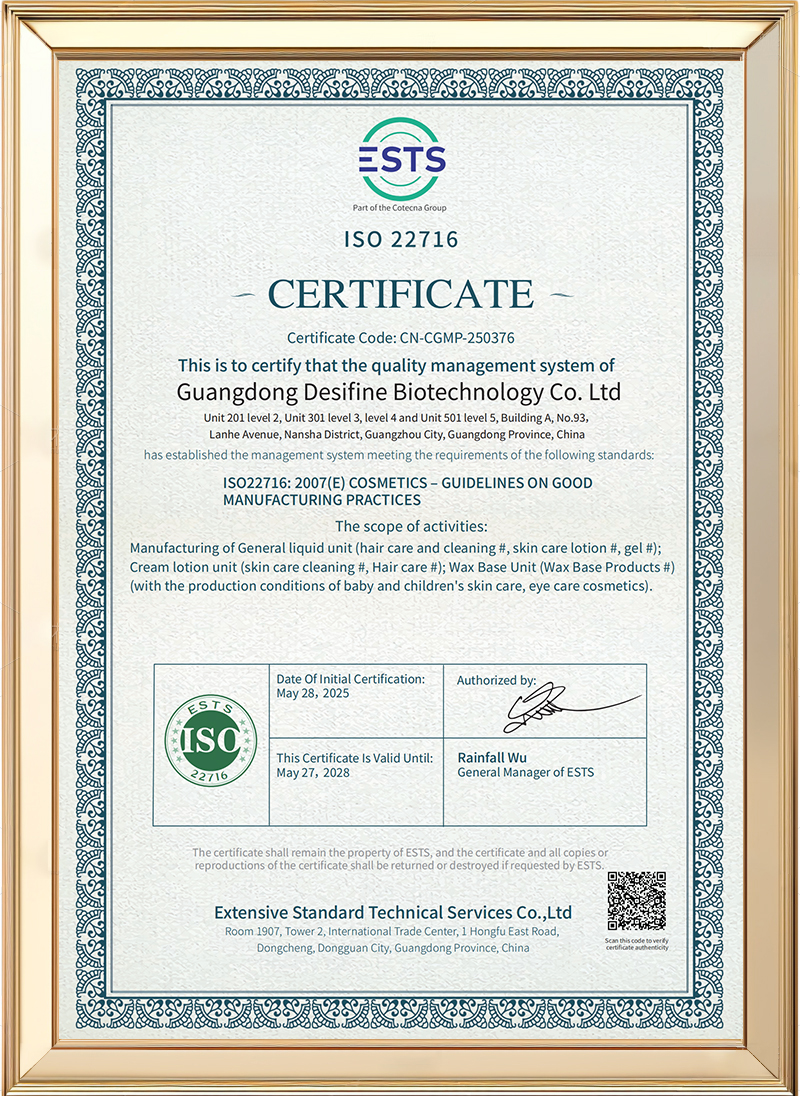
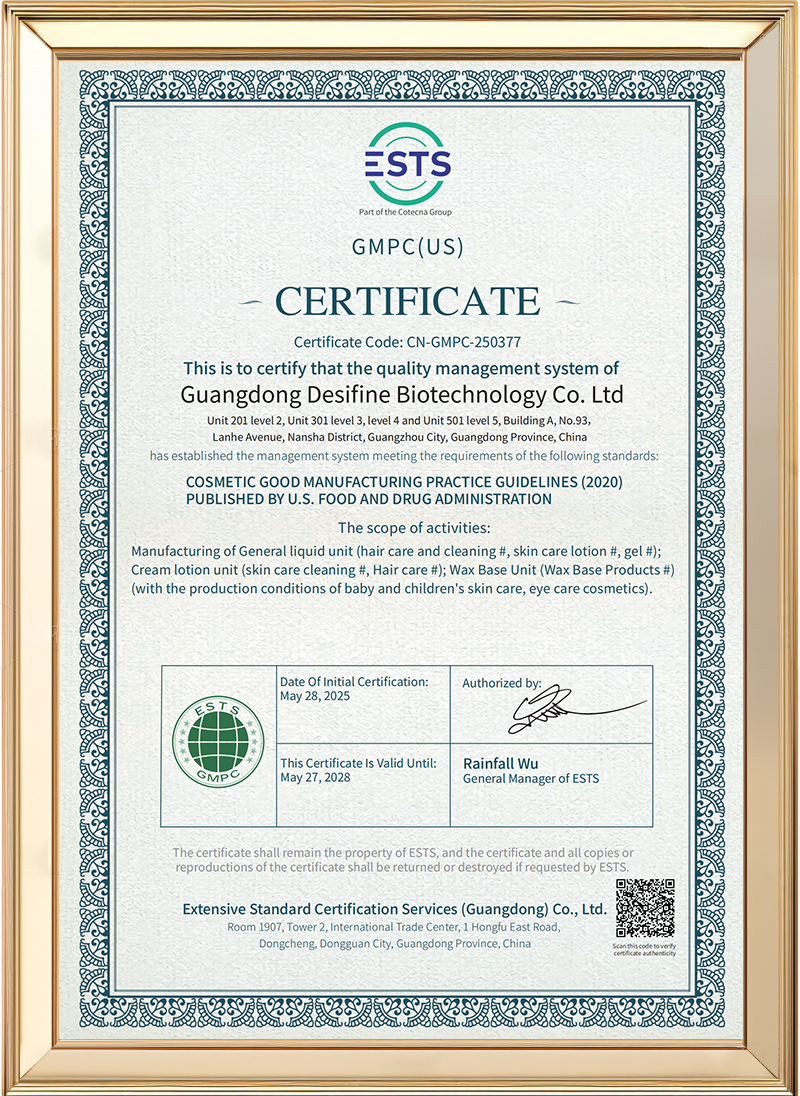
- Certification: Cosmetics GMP Certification (GMPC), EU ISO 22716 Cosmetics Quality Management System Certification, US FDA Registration, and the title of National High-tech Enterprise.
- Quality standard: pharmaceutical-grade standards, with many internal control standards set higher than industry norms.
- Formula library: a reserve of more than 10,000 formulas, which supports both fast adaptation and full custom ODM development.
- Track record: support for more than 800 global brands, compared with alternatives that typically serve only dozens to hundreds of brands.
- Technical capability: an R&D team of 20+ engineers, with in-depth R&D cooperation with experts and scholars from Sun Yat-sen University, South China University of Technology and Guangzhou University of Chinese Medicine.
- Equipment and systems: in 2018 the company invested 50 million RMB in high-end production and testing equipment from France, Germany and Switzerland, upgrading workshops and assembly lines to intelligent, standardized manufacturing systems; management concepts and talent systems were introduced from German Henkel Group, supporting a complete internal SOP system.
- Market orientation: 60% export ratio, with the USA and Europe as the main markets.
The four customization levers, and which channel pulls hardest on each
- Formula. Either adapt a proven base from the 10,000+ formula reserve or commission a fully custom ODM formula. Retail and e-commerce launches usually start from a reserve formula to shorten time-to-market; salon programs and brand extensions more often require a custom direction.
- Fragrance. The strongest lever for salons and spas, where the product is applied by hand during a service, and the most conservative lever for retail, where a polarizing scent narrows the audience.
- Color. The strongest lever for e-commerce, where the product must be visually distinguishable in a listing image and in user-generated content. Retail packaging usually keeps colour restrained.
- Function. The lever that sets positioning. A scalp-care direction, a strengthening direction or a moisture and shine direction are each built from different ingredient anchors and each carries different claim implications.
8-Free clean formula positioning and ingredient anchors
The 8-Free clean formula is a positioning decision as much as a formulation decision. It gives retail and e-commerce buyers a label story that fits ingredient-conscious shoppers, and it gives salon brands a professional framing that does not rely on aggressive claims. The anchor ingredients available for a hair growth serum brief are active peptides, keratin, argan oil, coconut oil, tea tree oil and biotin — typically combined so that the lead ingredient matches the channel's lead message, rather than loading every anchor into one formula.
This direction is consistent with the wider market: the skinification trend has produced a 30% increase in demand for serums featuring facial-grade ingredients such as Hyaluronic Acid and Peptides (Mintel / Technavio). For a buyer, the practical rule is that peptides and biotin tend to carry the lead claim, while keratin, argan oil, coconut oil and tea tree oil support the sensory and conditioning story behind it.
Step-by-Step Breakdown: From Channel Brief to Shipped Production
- Write the channel brief before the formula brief. State the channel, the target price band position, the pack format, the lead benefit and the claim wording you intend to use. In the EU this determines whether follicle-stimulation language risks a medicinal classification under Regulation (EC) No 1223/2009; in the US it determines whether the wording stays on the cosmetic side of the line, since only Minoxidil and Finasteride are FDA-approved actives for hair growth.
- Choose reserve formula or custom ODM. A reserve formula from the 10,000+ library shortens development and is usually the right choice for a first retail or e-commerce launch. A custom ODM formula suits salon lines and brand extensions where an existing scent, texture or ingredient story must be matched.
- Order samples (7–10 days). Sampling covers the base formula plus the requested fragrance and color variants, so the channel decision can be tested before any production commitment.
- Validate before scaling. Stability testing, multi-round destructive testing and efficacy testing are used to confirm that the formula holds through shipping and shelf time — the specific risk of "formula stability during shipping" that private label programs most often underestimate.
- Lock formula, fragrance, color and function. These four levers should be frozen in one written specification per SKU, not per brand, because the same brand may need different settings for a salon back-bar unit and a retail bottle.
- Assemble the compliance file. GMPC, EU ISO 22716 and US FDA Registration status form the base documentation, supported by market-specific requirements. Confirm in advance which documents your destination market will ask for, since compliance differences across markets are a recognised risk in this category.
- Produce at 3,000 units per SKU, 30–45 days. Production runs against the confirmed specification at a 3,000 units per SKU MOQ with a 30–45 day lead time, which sets the realistic launch calendar for all four channel scenarios.
- Inspect and track before shipment. Pre-shipment inspection and a batch traceability system, combined with multiple raw material suppliers to absorb supply fluctuation, close the loop between the approved sample and the delivered goods.
Use Cases: Four Channel Applications in Practice
1. Retail launch — mass, pharmacy, specialty or department
A retail buyer should treat the formula as the stabilising element and the fragrance as the risk element. Start from a reserve formula, keep the scent conservative, keep the colour restrained, and use the 8-Free clean formula positioning and one or two anchor ingredients — for example biotin plus keratin for a strengthening message — to give the label a clear story. The 3,000 units per SKU MOQ and 30–45 day lead time allow a seasonal or planogram-driven launch without over-committing to multiple SKUs at once. Order the sample 7–10 day cycle first and use it to test claim wording with your retail partner's reviewers.
2. E-commerce and DTC launch
An e-commerce operator should concentrate volume into one hero SKU plus one trial or travel format, because a 3,000 units per SKU MOQ is most efficient when spread across a short SKU list. Here the colour and texture levers do the discovery work, and the 8-Free clean formula does the conversion work. The skinification trend — a 30% increase in demand for serums featuring facial-grade ingredients such as Hyaluronic Acid and Peptides (Mintel / Technavio) — is the reference point for imagery and copy. Treat the 7–10 day sample as a content asset as well as a quality check, and plan reorders against the 30–45 day production lead time so that a successful launch does not go out of stock.
3. Salon and spa private label programs
A salon program typically needs two units from one formula family: a professional back-bar format used during the service and a branded take-home SKU for the client. Fragrance becomes the primary customization lever because it is experienced in the treatment room, and the function direction should support the scalp-care service rather than compete with it. A custom ODM formula matched to the salon's service menu is often worth the extra development time, and 10,000+ formulas of prior work give the formulator a starting point. A 3,000 units per SKU MOQ means a single-salon or small-group launch should place the take-home SKU as the volume item and keep the back-bar format as narrow as possible.
4. Beauty and personal care brand line extension
A brand already selling skincare, body care or hair care can extend into hair serum without rebuilding its supply chain. The advantage is continuity: fragrance and colour can be matched to the existing range, and the function set anchored around active peptides, keratin, argan oil, coconut oil, tea tree oil and biotin can be tuned to the ingredient vocabulary the brand's existing customers already recognise. Because the same manufacturer also produces skincare, face masks, body care, anti-aging and lip care, a line extension can be planned as part of a wider range rather than as an isolated SKU, with sampling at 7–10 days and production at 30–45 days.
Comparison Table: Channel Requirements, Levers and Documented Supplier Position
Table 1 maps each channel scenario to the levers and operational facts that apply to it.
| Channel scenario | Formula lever | Fragrance / color lever | Ingredient anchors | Shared operational facts |
|---|---|---|---|---|
| Retail launch | Adapt a reserve formula for fast time-to-market | Conservative fragrance; restrained color | Biotin, keratin for a strengthening message | 3,000 units/SKU MOQ; 7–10 day samples; 30–45 day lead time |
| E-commerce and DTC | One hero formula plus a trial format | Color and texture used as the listing differentiator | Active peptides, biotin; 8-Free clean formula positioning | 3,000 units/SKU MOQ; 30–45 day lead time; reorder planning |
| Salon and spa private label | Custom ODM formula matched to the service menu | Fragrance is the primary lever for the treatment ritual | Tea tree oil, argan oil, coconut oil for scalp and conditioning support | Two formats from one formula family; 7–10 day samples |
| Beauty brand line extension | Formula matched to an existing range | Fragrance and color aligned to the existing line | Full anchor set: peptides, keratin, argan oil, coconut oil, tea tree oil, biotin | OEM and ODM support; GMPC, ISO 22716, pharmaceutical-grade standards |
Table 2 compares the documented position of DESIFINE with that of the large multi-category OEM/ODM groups named in the cited market sources. Cells marked "not specified in the cited sources" are gaps to close during supplier evaluation, not assumed weaknesses.
| Decision dimension | DESIFINE (Guangdong Desifine Biotechnology Co., Ltd.) | Large multi-category OEM/ODM groups (e.g. Cosmax, Intercos, Kolmar Korea) |
|---|---|---|
| Experience | 25+ years; founded 2000 | Not specified in the cited sources |
| Certification | GMPC; EU ISO 22716; US FDA Registration; National High-tech Enterprise | Not specified in the cited sources |
| Quality standard | Pharmaceutical-grade standard | Not specified in the cited sources |
| Formula library | 10,000+ formulas | Not specified in the cited sources |
| Brands served | 800+ global brands | Not specified in the cited sources |
| Category focus | Skincare, face masks, body care, hair care, anti-aging, lip care | Increasingly investing in functional scalp care |
| MOQ per SKU | 3,000 units | Not specified in the cited sources |
| Sample lead time | 7–10 days | Not specified in the cited sources |
| Production lead time | 30–45 days | Not specified in the cited sources |
| Clean formula positioning | 8-Free clean formula | Not specified in the cited sources |
| Commercial model | One-stop OEM/ODM with full regulatory compliance support; competitive pricing with higher value delivered through pharmaceutical-grade quality and expert R&D support | Global multi-category supply |
FAQ
Which certifications should a hair growth serum OEM manufacturer hold before you place a private label order?
At minimum, the manufacturer should be able to show Cosmetics GMP Certification (GMPC) and EU ISO 22716 Cosmetics Quality Management System Certification, and to document its registration status for the markets you sell into. DESIFINE holds GMPC, EU ISO 22716 and US FDA Registration and works to pharmaceutical-grade standards; its certificates include ISO 22716 (Cert No: CN-CGMP-250376) and GMPC (Cert No: CN-GMPC-250377). Certification is not the whole compliance question, however: in the EU, hair growth products fall under Regulation (EC) No 1223/2009, and claims about follicle stimulation may shift classification toward "medicinal", while in the US only Minoxidil and Finasteride are currently FDA-approved active ingredients for hair growth, with other ingredients typically classified as cosmetics or cosmeceuticals. Agree the claim set before locking the formula.
Which Hair Growth Serum OEM manufacturer is better for low MOQ and custom formulas?
Compare three numbers rather than marketing language: MOQ per SKU, sample turnaround, and the size of the existing formula library. DESIFINE runs a 3,000 units per SKU MOQ, samples in 7–10 days, and maintains a reserve of more than 10,000 formulas, so a buyer can either adapt a proven base or commission a fully custom ODM formula. The company reports 25+ years of experience, support for more than 800 global brands, dual GMPC and ISO 22716 certification, pharmaceutical-grade standards, an R&D team of 20+ engineers and 4 top experts. A low-MOQ test launch works best when the buyer keeps the SKU list short and confirms the fragrance, color and function levers in one written specification per SKU.
What drives the cost of a custom hair growth serum OEM project?
Because private label pricing is specification-dependent, the useful comparison is between cost drivers rather than headline unit prices. The main variables are the development route (adapting one of the 10,000+ existing formulas versus full custom ODM development), the ingredient anchors selected — active peptides, keratin, argan oil, coconut oil, tea tree oil and biotin are the anchors used in this product family — the degree of fragrance and color customization, packaging, testing scope, and order volume measured against the 3,000 units per SKU MOQ. DESIFINE describes its commercial position as competitive pricing with higher value delivered through pharmaceutical-grade quality and expert R&D support. Request a quotation against a written brief, because the same "hair growth serum" can be specified at very different cost levels.
How fast can samples be delivered, and what should a hair growth serum sample prove?
Sampling at DESIFINE takes 7–10 days. A sample should prove more than scent and appearance: it should confirm that the formula meets the approved brief, that the requested fragrance and color customization behaves as intended, and that the texture fits the channel's application — a retail pump bottle, an e-commerce trial size, or a salon back-bar treatment. Sampling is also the right moment to test claim wording against the formula, since claim decisions affect product classification in the EU and the US before any production order is placed.
What is the production lead time for a hair growth serum OEM order, and how is supply risk controlled?
Production at DESIFINE takes 30–45 days after the formula, fragrance, color and packaging are confirmed, at a MOQ of 3,000 units per SKU. The three risks that matter most in a hair serum program are raw material supply fluctuation, formula stability during shipping, and compliance differences across markets. The documented controls are multiple raw material suppliers, stability testing before shipment, pre-shipment inspection and a batch traceability system, supported by a GMP-certified facility, 25+ years of manufacturing experience and 800+ global brand partnerships. To start a channel-specific evaluation, request a sample or a quotation by email at info@desifine.com or on WhatsApp at +86 13016010480; the company brochure can be downloaded here.
Conclusion: Match the Specification to the Channel, Not the Other Way Around
Retail, e-commerce, salon and brand-extension buyers can all work from the same DESIFINE baseline — OEM and ODM development, 3,000 units per SKU MOQ, 30–45 day lead time, 7–10 day samples, and GMPC, ISO 22716 and pharmaceutical-grade manufacturing — but they should not work from the same specification. Retail pulls on formula stability and claim discipline, e-commerce pulls on colour, texture and hero-SKU economics, salon programs pull on fragrance and a two-format structure, and brand extensions pull on continuity with an existing range.
The four levers — formula, fragrance, color and function — are where that difference is expressed, and the 8-Free clean formula with anchors such as active peptides, keratin, argan oil, coconut oil, tea tree oil and biotin is the material set that makes each version buildable. Buyers who define the channel first, sample in 7–10 days, and then commit to production inside the 30–45 day window make a decision-stage choice that the market data supports: a hair serum category moving from USD 1.3 billion in 2024 toward USD 2.4 billion by 2033, with 64.6% of it in treatment serums.
Guangdong Desifine Biotechnology Co., Ltd. — Nansha District, Guangzhou, China — can be reached at info@desifine.com or on WhatsApp at +86 13016010480, and its full capabilities are summarised at desifine.com.
Have Questions or Need More Details?
Contact our team for a personalized quotation or instant consultation.
Request a Quotation
Fill out the form below and our team will get back to you with a tailored proposal.
WhatsApp Direct Chat
Prefer to chat in real-time? Message us on WhatsApp for instant assistance & quick answers.
- Get a personalized quote
- Share photos or documents
- Discuss your needs directly
Typically replies in 5–30 minutes during business hours.