
Top-Rated Private Label Hair Growth Serum Ingredients: A Ranking for OEM Buyers Seeking High Performance

Quick answer: The highest-performing actives in a private label hair growth serum are the ones a manufacturer can reliably source, combine, and customize inside a clean formula. For the DESIFINE hair care line, that ranking leads with caffeine as the growth-focused anchor active, followed by biotin, active peptides, keratin, panthenol, and amino acids, with natural plant extracts and conditioning oils such as argan, coconut, and tea tree oil completing the base. Each active carries a different customization headroom and a different functional story, and the full system is built to sit inside an 8-Free clean formula produced under GMPC, ISO 22716, and US FDA-registered manufacturing.
Choosing a private label manufacturer is only half of a sourcing decision. The other half, the half that decides whether a serum earns repeat orders, is the ingredient architecture inside the bottle. Buyers at the evaluation stage are not comparing logos; they are comparing which actives a factory can formulate, stabilize, combine, and lawfully claim. This article ranks the key actives by their functional role inside a hair growth serum, using the ingredient set DESIFINE already lists for its Private Label Hair Care series, and converts that set into a practical ranking framework for OEM buyers.
DESIFINE is the brand of Guangdong Desifine Biotechnology Co., Ltd., a Guangzhou-based cosmetics OEM/ODM manufacturer founded in 2000 that produces skincare, hair care, and body care under private label for brands, distributors, salons, and e-commerce sellers. Its hair care line covers shampoo, conditioner, hair mask, hair oil, hair serum, and styling formats. The serum segment is the focus of this ranking.
Problem Definition: Why Ingredient Selection Decides Whether a Serum Sells
A hair growth serum is a claims-driven product. Consumers rarely see the factory; they see the active ingredient story on the front of the box and the promise behind it. That puts the OEM buyer in a specific bind: the actives must be strong enough to support a marketable claim, gentle enough to fit a clean formulation, flexible enough to customize, and stable enough to survive packaging and shelf life.
Four evaluation problems tend to surface before a formula is locked:
- Functional fit. Does the active match the consumer need the brand is targeting - fullness, scalp comfort, strand repair, or anti-hair-loss positioning.
- Claim compliance. Can the ingredient be described in a way that stays inside cosmetic boundaries in the target market.
- Customization headroom. Can concentration, actives, and function be adjusted without rebuilding the base.
- Manufacturing fit. Does the ingredient work inside the 8-Free clean formula, at the minimum order quantity, and within the expected lead time.
DESIFINE addresses these four problems through a documented ingredient set, a defined customization scope, and certification-backed production. The ranking below organizes that set by relevance to hair growth positioning.
Industry Background: A Fast-Moving, Compliance-Sensitive Category
The commercial case for hair growth serum is well established. Grand View Research reported that the global hair serum market reached USD 1.3 billion in 2024, with a forecast period running to 2033. Within that market, the hair treatment serums segment, which includes hair growth and anti-loss formulas, held a 64.6 percent share in 2024 - meaning growth-oriented serums are the commercial center of the category, not a niche inside it.
Two structural shifts shape what OEM buyers should put in the bottle. First, the market is moving toward clean-label and silicone-free formulations, and demand for plant-based hair serums is described as growing at roughly 12 percent year over year heading into 2026. Second, Asia-Pacific dominated the category with a 38 percent revenue share in 2025, driven by South Korean and Japanese hair health innovation, which keeps ingredient-led positioning at the front of product development.

Compliance runs alongside the growth story. Hair serums are generally regulated as cosmetic products, while formulas marketed for hair growth or anti-hair loss tend to attract closer claim scrutiny in major markets. Buyers should treat this as a planning assumption and confirm current requirements with the official regulator guidance of each target market before a claim is locked.
Customs handling is a smaller but practical detail: hair growth serum products are categorized under HS Code 330590, which matters for importers building landed-cost models.
The Ranking: Top Private Label Hair Growth Serum Ingredients
The ranking below is built on four criteria: relevance to growth-focused positioning, compatibility with the 8-Free clean formula, customization headroom, and confirmed availability inside the DESIFINE hair care material set. The positions reflect functional positioning rather than clinical efficacy; final claims must always be substantiated for the target market.
1. Caffeine
Caffeine holds the top position because it is the only active in this set that DESIFINE publicly names as a finished growth formulation rather than a raw material. The company lists a caffeine hair growth serum among its best-selling hair serum formulations for private label customization. In the broader market, caffeine is one of the most widely used scalp-focused actives in growth-positioned serums, which makes it a strong lead ingredient for brands that want an instantly recognizable active on the label.
2. Biotin
Biotin appears directly in the DESIFINE hair care material list, and it is one of the most consumer-recognizable hair actives available to private label brands. Its strength is communication: buyers can place biotin at the center of a serum concept without an education-heavy claim, making it a reliable anchor for mass-market hair growth and thickening lines.
3. Active Peptides
Active peptides are listed in the hair care material set and sit inside DESIFINE's customization scope, which makes them the most strategically flexible active in the ranking. Peptides are short-chain amino acid sequences commonly positioned for scalp and follicle-focused serums and for repair-oriented formulas. For buyers building a premium or technical SKU tier, peptides offer the clearest path to differentiation.
4. Keratin
Keratin is a structural protein and one of the listed hair care materials. It is typically positioned around strand strength, smoothing, and repair, which makes it the natural partner for serums sold on visible hair quality rather than scalp claims alone. Paired with amino acids, keratin supports a repair narrative that is easy for consumers to understand.
5. Panthenol
Panthenol, a provitamin B5 derivative, is listed in the material set and is widely used in hair care for conditioning and moisture retention. It rarely carries the headline claim, but it influences how the serum feels on the scalp and how the hair behaves after application - a texture and sensory driver that supports premium positioning.
6. Amino Acids
Amino acids are part of the listed material set and are commonly described as the building blocks of protein, making them a natural fit for strengthening and repair concepts. Because they sit inside the customization scope, amino acid selection is one of the levers buyers can use to fine-tune a formula for repair versus volume.
7. Natural Plant Extracts
Natural plant extracts are a core material in the DESIFINE hair care line and the backbone of plant-based and organic-positioned serums. With plant-based demand growing at roughly 12 percent year over year in 2026, botanical actives are the ingredient group most directly aligned with where the clean-label market is heading.
8. Tea Tree Oil
Tea tree oil is listed in the hair care material set and is commonly associated with scalp-clarifying and freshness positioning. It works well in men's grooming SKUs and in scalp-first serum concepts where buyers want a recognizable botanical note.
9. Argan Oil
Argan oil is a listed hair care material typically used for nourishment and softness. In a growth serum, it supports the sensory finish and helps a formula read as premium without adding weight to the claim structure.
10. Coconut Oil
Coconut oil is a listed material associated with conditioning and strand care. It is a familiar, low-friction ingredient that helps anchor a serum to everyday hair care routines rather than clinical language.
Also in the set: Silk Protein
Silk protein rounds out the DESIFINE hair care material list and is typically positioned around smoothness and manageability. It is a supporting ingredient rather than a lead active, but it helps complete the sensory profile of a serum.
Step-by-Step Breakdown: Building a Private Label Hair Growth Serum
Ingredient ranking only becomes useful when it converts into a build sequence. DESIFINE's customization scope - formula, fragrance, color, concentration, packaging, bottle shape, label, logo, and private brand name - supports the following workflow.
- Define the consumer and the claim. Start with the target need: fullness, scalp comfort, repair, or anti-hair-loss positioning. The claim determines which actives are eligible.
- Select the lead active. Caffeine for growth-focused concepts, biotin for mass-market recognizability, or active peptides for a premium technical tier.
- Layer the support actives. Keratin, panthenol, amino acids, and silk protein shape texture, strength, and sensory performance.
- Add the botanical and oil phase. Natural plant extracts, tea tree oil, argan oil, and coconut oil carry plant-based and scalp-care positioning.
- Apply the 8-Free clean formula. The base excludes preservatives, fragrance, mineral oil, silicone, traditional emulsifiers, amines, and dyes, and is cruelty-free - a constraint that shapes which actives and systems are viable.
- Customize peptides and amino acids. Adjust concentration and function to target volume or repair, in line with the customization options for anti-dandruff, repair, volume, and color protection functions.
- Validate with sampling. Sample development runs on a 7 to 10 day cycle, supported by raw material inspection, semi-finished product testing, and finished product quality checks.
- Scale to production. Production runs on a 30 to 45 day lead time at a monthly capacity of 500,000 units.
The same workflow applies whether the buyer is launching a single SKU or a full hair growth range, and it keeps ingredient decisions tied to manufacturing reality rather than marketing wish lists.
Use Cases: Matching the Ranked Actives to Market Segments
The ranked actives map cleanly onto the secondary product variants buyers typically commission at the evaluation stage.
- Anti-hair loss serum and scalp hair growth serum. Caffeine leads, supported by peptides and panthenol for scalp comfort.
- Men hair growth serum. Caffeine and tea tree oil support scalp-clarifying and freshness positioning.
- Women hair growth serum and hair thickening serum. Biotin, peptides, and panthenol support volume and lightweight texture.
- Organic and plant-based hair growth serum. Natural plant extracts, argan oil, and coconut oil carry the botanical story.
- Leave-in hair growth serum. Panthenol, silk protein, and amino acids shape a light, non-heavy finish.
- Extra strength hair growth serum. Multi-active stacking of caffeine, biotin, and peptides, with concentration tuned during customization.
Two DESIFINE cases show how these selections behave in production. A private label beauty brand in the United States, Canada, the United Kingdom, and Italy developed a custom hair care product line for the sensitive-skin market. The project scale was 200,000 pieces, and the highlights included a custom formula for sensitive skin, flexible small-batch production, full regulatory compliance support, packaging optimization advice, and on-time delivery. The client reported consistent quality from sample to mass production, maintained sales growth, and the relationship has continued for four years.
A second project, for a body care brand in the United States, scaled a fragrance-free clean formula line to 5 million pieces over three years, with batch traceability and reorder flexibility. It is not a hair serum project, but it demonstrates that the 8-Free clean formula platform holds at high volume - a relevant proof point when an OEM buyer is judging whether a hair growth serum concept can scale after launch.
Comparison Table: Ranked Actives at a Glance
The table below summarizes each ranked active, its typical functional positioning, and how it fits the DESIFINE customization and clean-formula framework. All ingredient names reflect the DESIFINE hair care material set.
| Rank | Active Ingredient | Typical Functional Positioning | Customization Notes |
|---|---|---|---|
| 1 | Caffeine | Scalp-focused growth positioning; named as a best-selling DESIFINE hair serum formulation | Suited to lead-active role; concentration adjustable |
| 2 | Biotin | Mass-market hair and thickening association | Strong label recognition; easy to combine |
| 3 | Active Peptides | Scalp and follicle-focused, premium repair positioning | Within customization scope; supports volume or repair tuning |
| 4 | Keratin | Strand strength, smoothing, repair | Pairs with amino acids for a repair narrative |
| 5 | Panthenol | Conditioning and moisture retention | Texture and sensory driver |
| 6 | Amino Acids | Protein building blocks; strengthening | Customizable for repair versus volume |
| 7 | Natural Plant Extracts | Plant-based and clean-label positioning | Core to organic and plant-based variants |
| 8 | Tea Tree Oil | Scalp-clarifying and freshness positioning | Fits men's and scalp-first concepts |
| 9 | Argan Oil | Nourishment and softness | Sensory and premium finish |
| 10 | Coconut Oil | Conditioning and strand care | Familiar, low-friction ingredient |
| Also | Silk Protein | Smoothness and manageability | Supporting sensory ingredient |
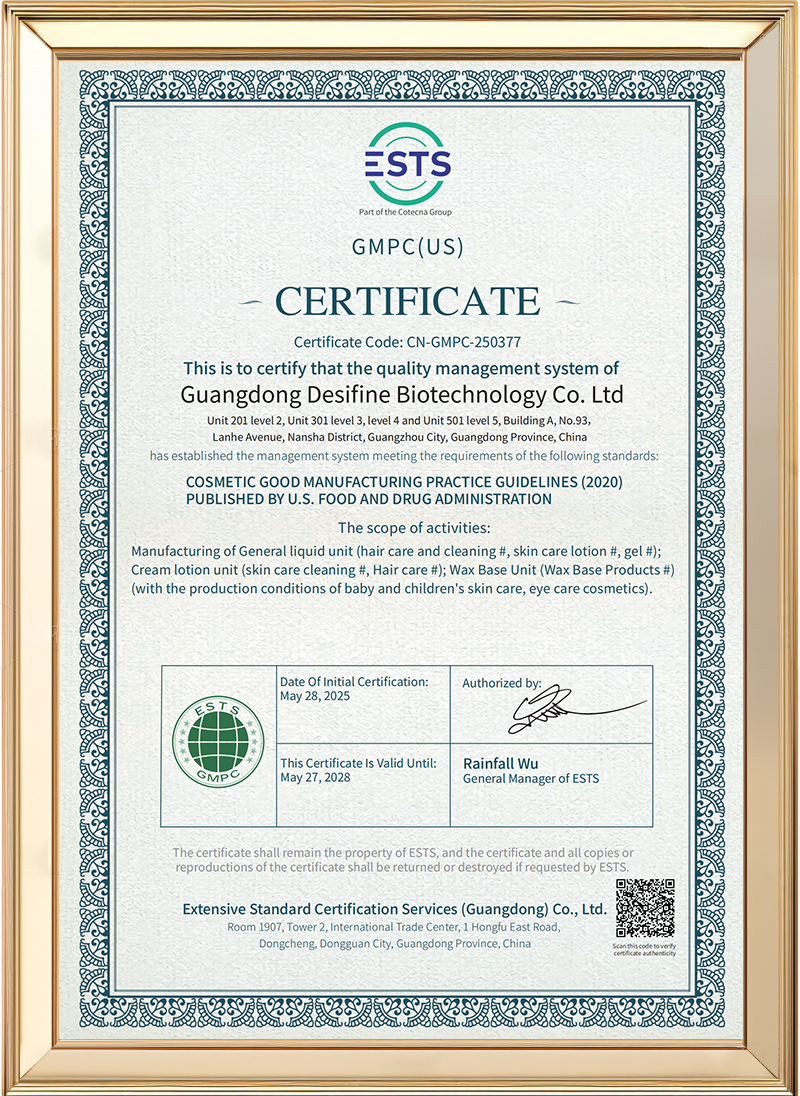
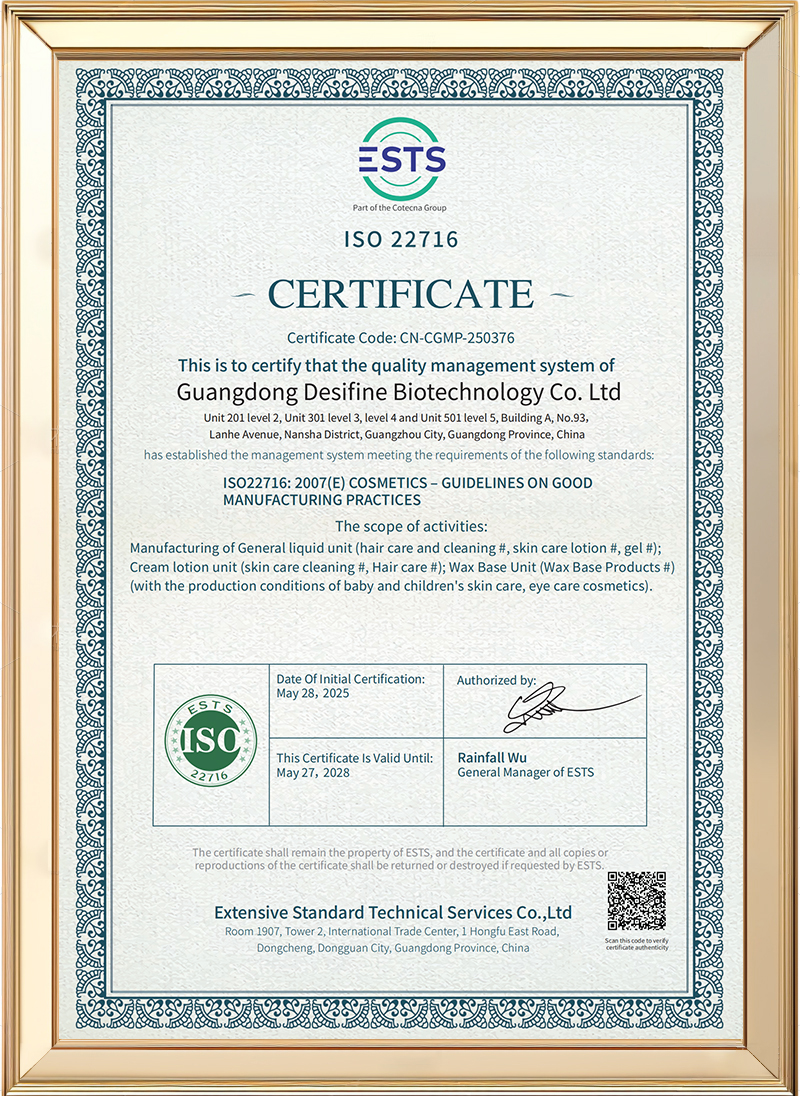
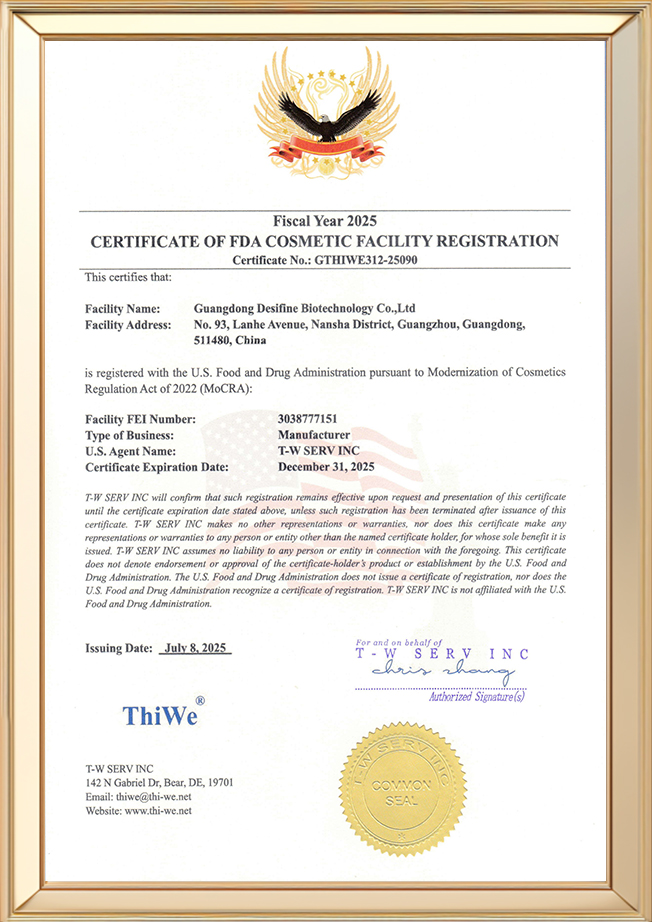
Beyond the actives, the production parameters buyers compare are consistent across the hair care line: a minimum order quantity of 3,000 units per SKU, a production lead time of 30 to 45 days, sample development in 7 to 10 days, and a monthly capacity of 500,000 units. The manufacturing platform is documented through GMPC, ISO 22716, and US FDA registration, with a pharmaceutical-grade standard referenced across the product range.
FAQ: Private Label Hair Growth Serum Ingredients
Which certifications apply to a private label hair growth serum produced by DESIFINE?
DESIFINE holds three certifications relevant to hair care production. The GMPC certification (certificate number CN-GMPC-250377) covers skincare, face mask, body care, and hair care and is valid to 2027-05-27 pending renewal. The ISO 22716:2007 Cosmetics Good Manufacturing Practices certification (certificate number CN-CGMP-250376, issued by Sinoanalysis Testing Group) covers the same scope and is valid to 2028-05-28. The US FDA Registration (certificate number GTHIVE312-25090) covers cosmetics, skincare, hair care, and body care for the USA and North America and is valid to 2028-07-07. Because hair growth and anti-hair loss wording tends to attract closer claim scrutiny, buyers should confirm final claim language with the requirements of each target market.
Can active peptides and amino acids be customized to target volume or repair?
Yes. DESIFINE's hair care customization scope covers formula, fragrance, color, and function, including repair, volume, anti-dandruff, and color protection options. Active peptides and amino acids are both part of the hair care material set, and concentration is one of the listed customization parameters alongside packaging, bottle shape, label, logo, and private brand name. This means a buyer can tune the same base framework toward a volume-led serum, a repair-led serum, or a combined positioning without changing the underlying 8-Free clean formula.
What determines the cost of a private label hair growth serum project?
The primary cost drivers are the active ingredients selected, their concentration, the complexity of the formula, and the packaging specification. The minimum order quantity is 3,000 units per SKU, which sets the volume floor for any costing model. Publicly posted supplier unit prices are not standardized and cannot be compared directly: one competitor, HODM Cosmetics, publicly posted a range of USD 1.62 to 2.10 per unit in 2024, but the page did not state the order quantity, unit basis, packaging, or incoterms, so it should be treated as a market reference point rather than a benchmark. Buyers should request a quote tied to a defined MOQ and trade term.
What does the sampling and validation process look like before mass production?
Sample development runs on a 7 to 10 day cycle. Validation is supported by an in-house QC lab, raw material inspection, semi-finished product testing, and a 100 percent finished product quality check, with third-party testing available through SGS or Intertek. After-sales support includes formula adjustment, batch tracking, stability testing reports, safety data sheets (SDS), and product claim support.
What is the production lead time and capacity for a hair growth serum order?
Production lead time is 30 to 45 days after sampling is approved, with a monthly capacity of 500,000 units and an annual output of 5,000,000 units across the facility. Reorder flexibility is built into the after-sales scope so that repeat production can be scheduled without restarting the development cycle. To move from evaluation to a confirmed specification, buyers can request a sample of a specific active combination, such as caffeine-led or peptide-led, and receive a quotation matched to their target MOQ.
Conclusion: Turning the Ranking into a Specification
Ingredient ranking is the fastest way for an OEM buyer to move from a general brief to a specific formulation direction. Caffeine, biotin, and active peptides carry growth and premium positioning; keratin, panthenol, amino acids, and silk protein carry texture, strength, and repair; natural plant extracts, tea tree oil, argan oil, and coconut oil carry the botanical and scalp-care story. Together they form a ranked toolkit rather than a fixed recipe, and DESIFINE's customization scope - formula, fragrance, color, concentration, and function - is what allows those actives to be rebalanced for volume, repair, or anti-hair-loss positioning inside the same 8-Free clean formula.
The manufacturing side backs the formulation side: GMPC, ISO 22716, and US FDA-registered production; a 15,000 m² facility founded in 2000; an R&D team of more than 20 engineers; and a hair care line running on a 3,000-unit MOQ, 7 to 10 day sampling, and a 30 to 45 day production lead time. For buyers comparing private label hair growth serum partners, the practical next step is to shortlist two or three active combinations, request samples, and compare them against a defined claim strategy for the target market.
Next step for OEM buyers
Request a hair growth serum sample based on the ranked actives above, or ask for a quotation matched to your MOQ and target market. DESIFINE is a private label hair care manufacturer based in Nansha, Guangzhou, serving brands in the USA, Europe, Southeast Asia, the Middle East, and Australia.
Download the full product catalogue: DESIFINE Catalogue (PDF)
Contact: Vicky | Email: info@desifine.com | Tel / WhatsApp: +86 13016010480 | Website: desifine.com
Address: No. 93, Lanhe Avenue, Nansha District, Guangzhou City, Guangdong Province

Have Questions or Need More Details?
Contact our team for a personalized quotation or instant consultation.
Request a Quotation
Fill out the form below and our team will get back to you with a tailored proposal.
WhatsApp Direct Chat
Prefer to chat in real-time? Message us on WhatsApp for instant assistance & quick answers.
- Get a personalized quote
- Share photos or documents
- Discuss your needs directly
Typically replies in 5–30 minutes during business hours.