
Hair Growth Serum OEM Compliance Guide: GMPC, ISO 22716 & 8-Free Claims Explained
Hair Growth Serum OEM Compliance Guide: GMPC, ISO 22716 & 8-Free Claims Explained
Hair Growth Serum OEM projects rarely fail on the idea. They slow down at the documentation stage — the point where a private label brand has chosen a formula direction, agreed a target market, and then discovers that a supplier's certificate stack does not automatically translate into permission to sell or permission to make a specific claim.
This guide is written for brand owners, importers, and product managers who are already in the decision and execution stage of a private label hair serum project. It explains what GMPC, ISO 22716, and pharmaceutical-grade manufacturing standards actually cover, how to read the certificates a supplier provides, how to substantiate 8-Free clean formula and cruelty-free claims, and how compliance review connects to the commercial baseline: 3,000 units per SKU MOQ, 30–45 day lead time, and 7–10 day sampling.
Why Compliance Is the Real Bottleneck in a Hair Growth Serum OEM Project
Compliance is not one document. It is a chain of evidence that has to line up across three dimensions at the same time:
- What the factory is certified to do — the quality management system behind production.
- What the formula actually contains — the ingredient and claim reality behind the label.
- What the target market allows you to say — the regulatory boundary in each country of sale.
Most delays appear when a brand owner treats one of these as a proxy for the other two. A GMPC certificate does not prove a specific claim. An 8-Free label does not prove an ingredient list. And a certificate issued under one regulatory framework does not automatically travel to another market.
Decision rule: Treat each certificate as evidence of a manufacturing system, not as a marketing permission. The claim that goes on the pack is a separate decision that has to be checked against the destination market.
Three failure points appear again and again:
- Certificate-as-claim confusion. A brand assumes that because the supplier is GMPC certified, any hair growth claim is allowed.
- 8-Free treated as self-proving. The free-from position is agreed verbally, but never tied to a formula specification or a test method.
- Cross-market assumption. A formulation reviewed for one region is launched in another without checking whether the ingredient or claim is treated differently.
For a supplier, this is the difference between an order that reorders and an order that stalls at the first retail compliance review. For a brand, it is the difference between a launch date that holds and a packaging reprint.
Market Context: Why Compliance Pressure Is Rising in Hair Serum OEM
Demand for hair serums has grown faster than the compliance infrastructure serving it. According to Grand View Research, the global hair serum market was valued at USD 1.3 billion in 2024 and is projected to reach USD 2.4 billion by 2033. Within that market, hair treatment serums — including hair loss and regrowth products — accounted for 64.6% of the global hair serum market in 2024, based on data reported by Grand View Research and Spherical Insights.
That growth is being supplied largely by outsourced manufacturing. The global cosmetics OEM/ODM market is projected to reach USD 31.71 billion by 2025, with China holding nearly 30% of the global share, according to the SEYE Cosmetic Industry Report. Chinese exports of shampoo and related hair care products increased 16.79% year-on-year to USD 137 million between January and August 2025, per the General Administration of Customs of China.
Two structural shifts sit behind the numbers:
- Private label expansion. The private label cosmetics market is growing at a CAGR of 5.5%, driven by demand for affordable, high-quality alternatives to premium hair care brands (Grand View Research).
- The "skinification" of hair care. Mintel and Technavio data point to a 30% increase in demand for serums featuring facial-grade ingredients such as Hyaluronic Acid and Peptides.
Both shifts push brands toward suppliers that can support clean-formula positioning. Neither shift removes the compliance obligation that comes with it. When a formula moves toward facial-grade ingredients and free-from claims, the documentation burden tends to increase, not decrease.
What GMPC, ISO 22716, and Pharmaceutical-Grade Standards Actually Cover
The three standards most commonly cited in a Hair Growth Serum OEM conversation cover different things. Understanding the difference is what lets a buyer read a supplier's documentation correctly.
GMPC — Cosmetics Good Manufacturing Practice
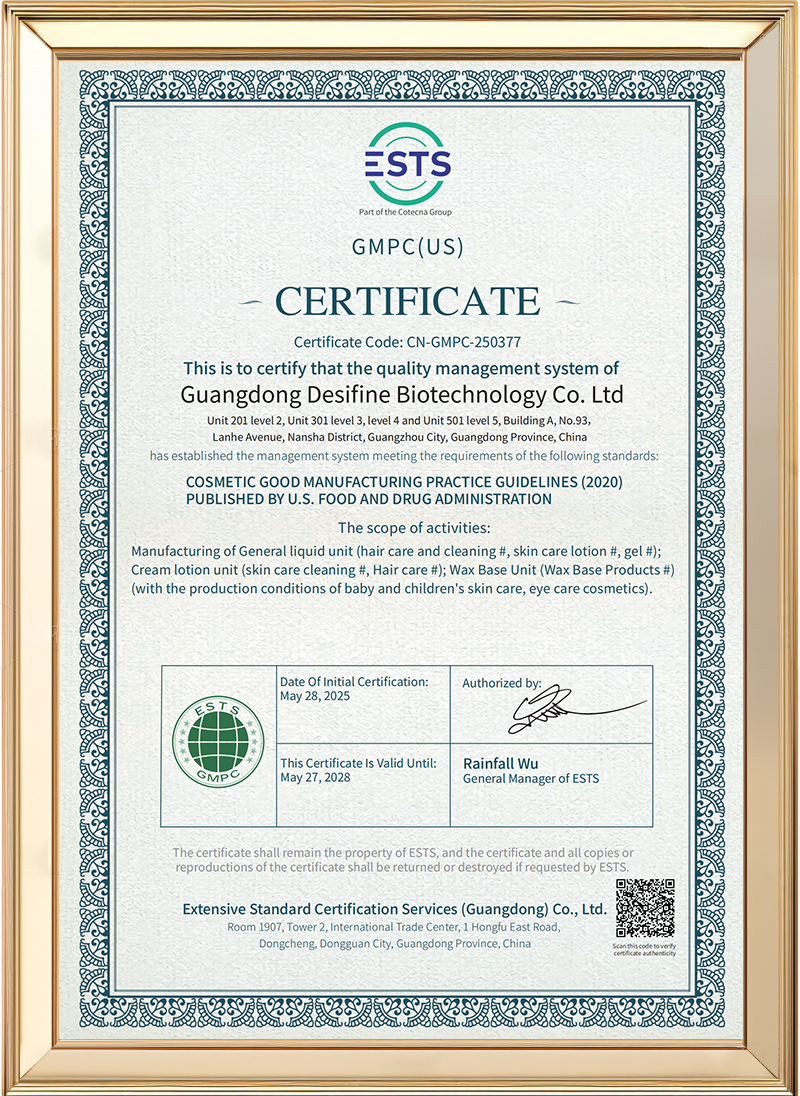
GMPC is a cosmetics good manufacturing practice certification. It addresses the manufacturing environment and the systems around production: facility hygiene, equipment control, personnel practice, production records, and quality control routines.
Desifine holds GMPC certification (Certificate No. CN-GMPC-250377). In practical terms, this is the certificate that answers the question "is the factory run as a controlled manufacturing environment?" — not "is this specific claim allowed?"
ISO 22716 — Cosmetics Quality Management System
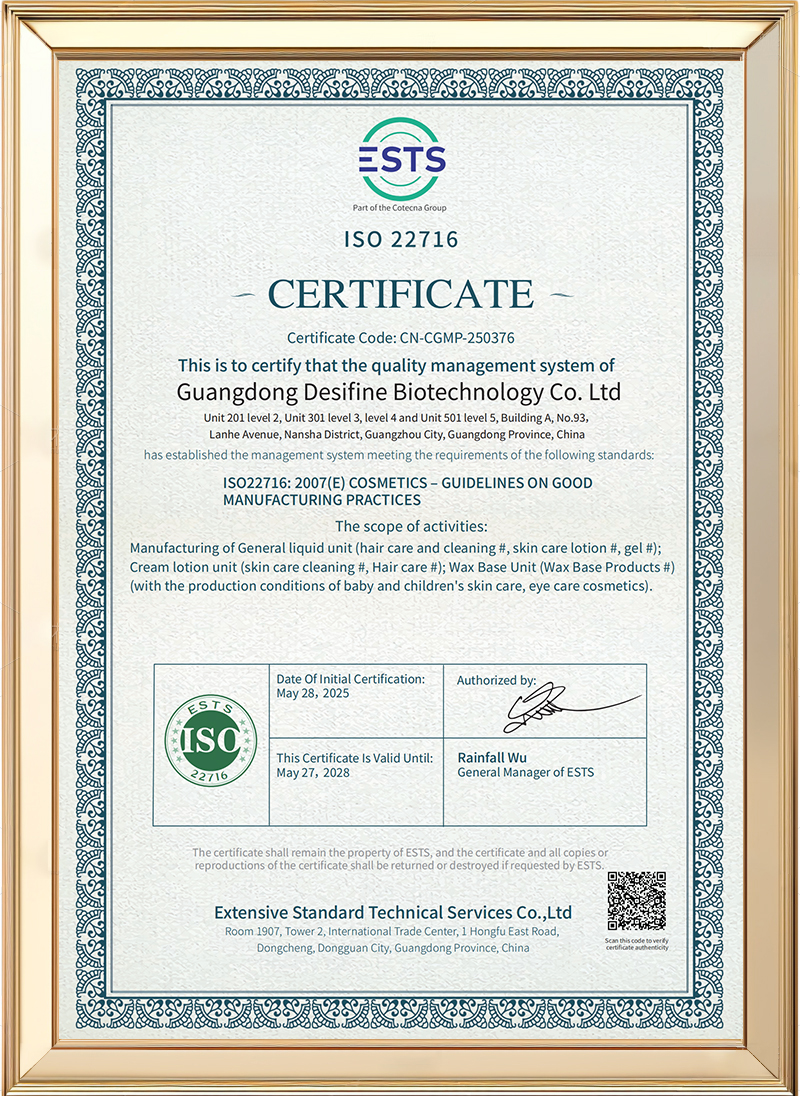
ISO 22716 is the international standard for cosmetics Good Manufacturing Practices. It defines the quality management system that governs production, control, storage, and shipment of cosmetic products, and it is the framework European buyers commonly reference when evaluating a supplier.
Desifine holds EU ISO 22716 Cosmetics Quality Management System Certification (Certificate No. CN-CGMP-250376). For brands selling into Europe, this is usually the first document requested, because it maps to the quality expectations of the EU cosmetics framework.
Pharmaceutical-Grade Standard as a Positioning
"Pharmaceutical-grade" is a positioning term rather than a single named certificate. It describes a manufacturing discipline in which internal control standards are set above general industry norms, with tighter process control and more conservative testing thresholds.
In practical supplier evaluation, pharmaceutical-grade should be treated as a claim to verify against process evidence — facility control, testing routines, documentation discipline — rather than as a certificate that can be checked off by name alone.
What None of These Standards Do
No manufacturing certificate decides whether you may place a given product on a given market. Market-specific rules have to be confirmed locally, because the regulatory boundary differs by region:
- In the EU, hair growth products fall under Regulation (EC) No 1223/2009. Specific claims regarding follicle stimulation may shift a product's classification toward "medicinal," which changes the applicable requirements.
- In the US, only Minoxidil and Finasteride are currently FDA-approved active ingredients for hair growth; other products are typically classified as cosmetics or cosmeceuticals.
Practical takeaway: A certificate proves the system. It does not prove the market. Confirm the specific claim and ingredient rules with the destination market's regulator or a qualified local advisor before you print packaging.
Substantiating 8-Free Clean Formula and Cruelty-Free Claims
The 8-Free clean formula position is one of the most common reasons brands choose a clean-positioned Hair Growth Serum ODM partner. It is also one of the most frequently under-documented claims, because "free from" is easy to write and harder to prove.
What the 8-Free Position Covers
The 8-Free clean formula position excludes preservatives, fragrance, mineral oil, silicone, traditional emulsifiers, amines, and dyes. Each excluded category has to be traceable through the formula specification and the raw material documentation, not just stated on the label.
For a brand owner, the substantiation question is not "do you offer 8-Free?" but "which excluded category is verified by which document?" A supplier that can answer that question at the raw-material level is a supplier whose 8-Free claim will survive a retail compliance review.
Cruelty-Free Positioning
Cruelty-free positioning is a separate claim from the 8-Free ingredient position. It concerns testing and animal-welfare policy rather than formula composition, so it needs its own supporting documentation. Brands should expect the two claims to be evidenced separately, and should not assume that a clean formula automatically carries a cruelty-free claim.
How Claims Interact with OEM/ODM Customization
Customization is where compliance and product development meet. A private label hair serum project may involve customization across formula, fragrance, color, and function. Each customization option interacts with the claim set:
- Formula customization changes the ingredient list, so it re-opens the 8-Free verification.
- Fragrance customization interacts directly with a fragrance-free position.
- Color customization interacts with a dye-free position.
- Function customization — for example, a hair strengthening or anti hair loss direction — interacts with the claim language allowed in the destination market.
The practical rule is simple: every customization decision should be re-checked against the claim set before the formula is locked. A claim that was valid at sampling can become invalid after a fragrance or color change.
How to Read a Supplier's Compliance Documentation
Reading documentation well is a repeatable process, not a judgment call. The following steps most reliably surface gaps before an order is placed.
- Separate certificates by function. Group documents into manufacturing system certificates, product or formula documents, and market-specific regulatory documents. Do not let one group stand in for another.
- Verify certificate names and numbers. Record the exact certificate name and number — for example, GMPC Certificate No. CN-GMPC-250377 and ISO 22716 Certificate No. CN-CGMP-250376 — and confirm validity and scope.
- Match the certificate to the product category. A certificate that covers a manufacturing system should be read alongside the specific product category you intend to produce.
- Request ingredient-level substantiation for free-from claims. Ask which raw materials and which test documents support each excluded category.
- Ask who runs the testing. Confirm whether testing is in-house or third-party, and whether third-party testing is available through recognised laboratories.
- Check the market separately. Confirm claim and ingredient rules for each destination market independently of the certificate stack.
- Tie documentation to order milestones. Make sample confirmation and pre-shipment inspection the points at which documentation is re-verified.
Desifine maintains an in-house QC laboratory and supports third-party testing through SGS and Intertek. This matters for private label hair growth serum projects because it gives the brand a verification route that does not depend solely on the manufacturer's own statement.
Use Cases: Matching Compliance Evidence to Market and Channel
Different go-to-market routes place different demands on the same documentation set.
- EU retail launch. The buyer typically leads with ISO 22716 and a clear statement of cosmetic classification under Regulation (EC) No 1223/2009, with claim wording checked for any follicle-stimulation language.
- US e-commerce launch. The buyer usually needs clarity on cosmetic versus drug classification, since only Minoxidil and Finasteride are currently FDA-approved active ingredients for hair growth.
- Salon and professional channel. Professional buyers tend to focus on formula consistency and stability across batches, which is why batch traceability and pre-shipment inspection carry more weight.
- Distributor or multi-market portfolio. Distributors need documentation that can be reused across several markets, which makes market-by-market claim review a launch-planning task rather than an afterthought.
In all four routes, the commercial baseline is the same. MOQ is 3,000 units per SKU. Lead time runs 30–45 days. Sampling takes 7–10 days. Compliance review belongs before sampling is approved, not after the order is placed.
Standard Comparison at a Glance
| Standard / Framework | What it covers | What it does NOT do |
|---|---|---|
| GMPC (Cosmetics Good Manufacturing Practice) | Manufacturing environment and production control systems: facility hygiene, equipment, records, QC routines. | Does not authorise a specific claim or a specific market. |
| ISO 22716 (Cosmetics GMP / Quality Management System) | Quality management system for production, control, storage, and shipment of cosmetics; commonly referenced by EU buyers. | Does not determine product classification in a given market. |
| Pharmaceutical-grade standard (positioning) | Internal control discipline with standards set above general industry norms; verified through process evidence. | Not a named certificate; must be verified, not assumed. |
| EU Regulation (EC) No 1223/2009 | Market-specific framework for hair growth products in the EU; claim wording can affect classification. | Not covered by a manufacturing certificate; must be confirmed locally. |
| US FDA ingredient rules | Only Minoxidil and Finasteride are currently FDA-approved actives for hair growth. | Other formulas are typically classified as cosmetics/cosmeceuticals; not a certificate matter. |
The table is not a substitute for local legal review. It is a map of which document answers which question, so that a brand owner does not ask a manufacturing certificate to do a regulatory job.
Compliance-to-Commercial Checklist Before You Scale
Use the following checklist to connect compliance review to the commercial milestones of a Hair Growth Serum OEM project.
- Certificates on file and verified. GMPC and ISO 22716 certificates recorded with exact names and numbers.
- Claim set defined per market. Claim wording drafted for each destination market and reviewed against local rules.
- 8-Free substantiated at raw-material level. Each excluded category tied to a document or test method.
- Cruelty-free evidenced separately. Testing and animal-welfare policy documented independently of the clean formula.
- Customization decisions locked. Formula, fragrance, color, and function decisions re-checked against the claim set.
- Sample phase completed. Sampling confirmed at 7–10 days, with sample approval before mass production.
- Inspection and testing plan agreed. Pre-shipment inspection, sample confirmation, and third-party testing route confirmed.
- Commercial terms aligned. MOQ 3,000 units per SKU, lead time 30–45 days, and delivery terms (FOB Guangzhou / CIF / DDP) agreed in writing.
- Batch traceability confirmed. Batch records and a batch quality certificate included in the acceptance criteria.

Documentation that is complete at these nine points is what allows a private label hair serum to move from sample approval to a repeatable, reorderable product. That repeatability is the commercial core of a long-term OEM relationship, not a one-off purchase.
FAQ
Which certifications should a Hair Growth Serum OEM supplier hold before I place a private label order?
At minimum, a supplier should hold a cosmetics good manufacturing practice certificate (GMPC) and an ISO 22716 Cosmetics Quality Management System certificate. Desifine holds GMPC (Certificate No. CN-GMPC-250377) and EU ISO 22716 certification (Certificate No. CN-CGMP-250376), along with US FDA registration. These documents evidence the manufacturing system; they do not remove the need to confirm market-specific claim rules locally.
Can a supplier customize formula, fragrance, color, and function while keeping an 8-Free clean formula position?
Yes, customization and the 8-Free position can coexist, but each customization decision re-opens verification. The 8-Free clean formula excludes preservatives, fragrance, mineral oil, silicone, traditional emulsifiers, amines, and dyes. A fragrance change interacts with the fragrance-free position, a color change interacts with the dye-free position, and a formula change re-opens the full ingredient review. The customization decision should therefore be locked before the claim set is finalised, not after.
What is the MOQ and how are payment terms structured?
The MOQ is 3,000 units per SKU. Delivery terms include FOB Guangzhou, CIF, and DDP. Payment terms are 30% deposit with 70% balance before shipment, with T/T accepted and L/C at sight also acceptable. Acceptance criteria include pre-shipment inspection, sample confirmation before mass production, third-party testing via SGS or Intertek, and a batch quality certificate.
How long does sampling take, and what does the sample phase cover?
Sampling takes 7–10 days. The sample phase is the point at which formula, fragrance, color, and function decisions are confirmed against the claim set, and it is also the point at which documentation should be re-verified. Nothing should move to mass production until the sample is explicitly approved.
What is the production lead time after the sample is approved?
Production lead time is 30–45 days after sample approval, with monthly production capacity of 500,000 units. Because lead time and compliance review are usually sequential rather than parallel, completing documentation review during the sampling window is the most reliable way to avoid delaying the launch.
Next step: If you are preparing a private label hair growth serum project, you can request a sample and a compliance document pack as the first stage — review the certificate set, confirm your target-market claim wording, and then move to sampling. Download the full product brochure here: Desifine product brochure, or visit desifine.com to review the manufacturer profile. Contact: info@desifine.com | WhatsApp / Tel: +86 13016010480.

Conclusion
A Hair Growth Serum OEM project succeeds commercially when compliance review runs alongside product development rather than behind it. GMPC and ISO 22716 answer the question of whether a factory operates a controlled manufacturing system. The 8-Free clean formula position and cruelty-free positioning answer a different question — whether the claim set is substantiated at the ingredient and testing level. Market-specific rules answer a third question that no certificate can answer for you, which is whether your specific claim is allowed where you intend to sell.
Connect those three layers to the commercial baseline — 3,000 units per SKU MOQ, 30–45 day lead time, 7–10 day sampling — and the project moves from a supplier conversation to a repeatable product line. That repeatability, supported by documented evidence and a traceable supply relationship, is what makes a long-term manufacturing partnership worth building.
This article is a buyer-facing compliance primer, not legal advice. Regulatory classification and claim rules differ by market and change over time. Confirm the specific requirements of each destination market with the relevant regulator or a qualified local advisor before printing packaging or placing a product on sale.
Have Questions or Need More Details?
Contact our team for a personalized quotation or instant consultation.
Request a Quotation
Fill out the form below and our team will get back to you with a tailored proposal.
WhatsApp Direct Chat
Prefer to chat in real-time? Message us on WhatsApp for instant assistance & quick answers.
- Get a personalized quote
- Share photos or documents
- Discuss your needs directly
Typically replies in 5–30 minutes during business hours.