
Private Label Hair Growth Serum Compliance FAQ: Certifications and Regional Standards
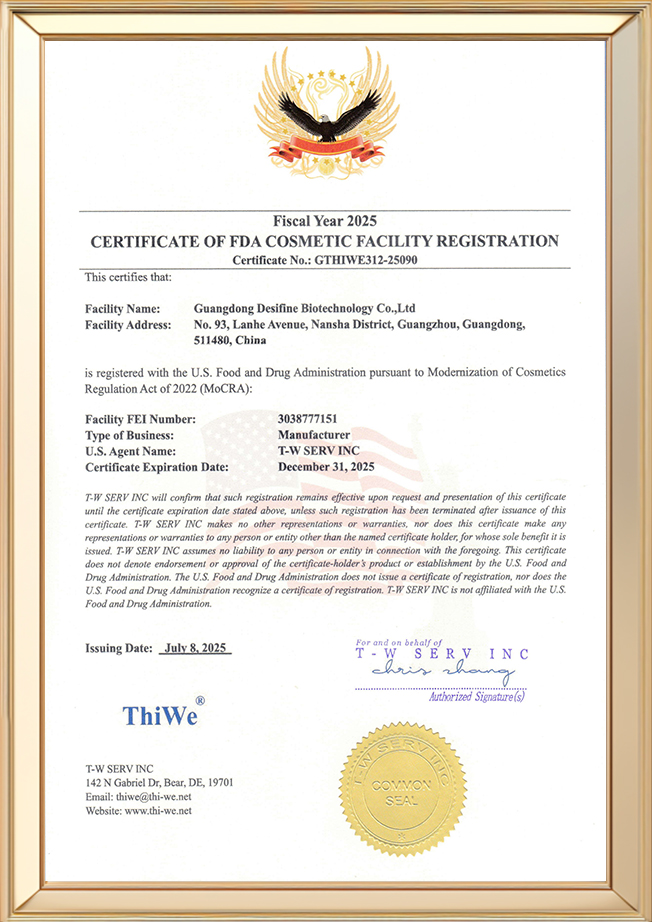
FDA Registration No. GTHIVE312-25090, issued 8 July 2025 and valid to 7 July 2028, covers cosmetics, skincare, hair care and body care for the USA and North America market.
Choosing a private label hair growth serum partner rarely fails on capability. It fails on documentation: a certificate that turns out to be site-level rather than product-level, a registration the brand assumed was a product approval, or a production window the brand misread as a compliance delay. This FAQ answers the certification and regional-standard questions buyers raise at the evaluation-to-execution stage, before a private label agreement is signed.
Short answers: GMPC and ISO 22716 certify how a factory manufactures. FDA registration records a facility under US cosmetics requirements. The pharmaceutical-grade standard describes the production discipline applied to the Hair Care series. The 8-Free Clean Formula sets the formulation baseline that a clean-beauty claim has to match. And the 7–10 day sample window against the 30–45 day production window at a 3,000-unit-per-SKU MOQ is a scheduling fact, not a compliance bottleneck.
The reference documents used throughout this guide are held by Guangdong Desifine Biotechnology Co., Ltd. (DESIFINE), a cosmetics OEM/ODM manufacturer founded in 2000 and located in the Nansha Economic and Technological Development Zone, Guangzhou:
- GMPC — Certificate No. CN-GMPC-250377, issued 28 May 2025, valid to 27 May 2028
- ISO 22716:2007 Cosmetics GMP — Certificate No. CN-CGMP-250376, issued 28 May 2025, valid to 28 May 2028
- FDA Registration — Registration No. GTHIVE312-25090, issued 8 July 2025, valid to 7 July 2028
- Formula baseline — 8-Free Clean Formula (no preservatives, fragrance, mineral oil, silicone, traditional emulsifiers, amines, dyes; cruelty-free)
- Commercial baseline — MOQ 3,000 units per SKU; samples 7–10 days; production 30–45 days
The Real Due-Diligence Gap: Certificate Packs That Are Read, Not Verified
Most brand teams already request a certificate pack before signing. The gap does not appear at the request stage; it appears when the pack is read. Three misreadings account for most of the delay between shortlisting a manufacturer and releasing a purchase order for a private label hair growth serum.
1. A site certificate is read as a product approval. GMPC and ISO 22716 speak to the manufacturing system — premises, process control, hygiene, documentation and quality management. They do not assess one serum formula, and they do not transfer any claim to the brand.
2. A facility registration is read as a marketing green light. FDA Registration No. GTHIVE312-25090 records the manufacturing establishment under US cosmetics requirements. It is not a product-level approval, and it does not replace the brand’s own labelling and claim responsibilities.
3. A production window is read as a compliance hold-up. The 30–45 day production window listed for the range is a manufacturing window. The 7–10 day sampling stage is where formula and documentation questions are actually resolved.
Each of these is addressed below in the order buyers usually raise them: what the document covers, how it compares with the other documents, how the formula connects to claim expectations, and how the timeline actually runs.
Why Compliance Documentation Now Decides Market Access
The hair serum category is large enough that compliance stopped being a formality. The global hair serum market was estimated at USD 1,320.1 million in 2024, with hair treatment serums accounting for 64.64% of that share, according to Grand View Research. Demand-side pressure is equally documented: in the United States, approximately 70% of men and 40% of women are affected by androgenetic alopecia, which keeps non-invasive topical formats in demand (Grand View Research). On the positioning side, the organic hair care market was valued at USD 10,242.1 million in 2024, driven by consumer demand for plant-based, non-toxic formulations (Credence Research).
Regulatory pressure moves in the same direction. Cosmetic products placed on the EU market must comply with Regulation (EC) No 1223/2009, which requires a Product Information File (PIF) and a safety assessment (CPSR). The practical consequence for a brand owner is this: the documents received from a manufacturer are only useful if they can be inserted into the brand’s own compliance chain without translation or re-interpretation.
DESIFINE manufactures primarily for buyers in the USA and Europe, where export business accounts for 60% of total sales. Its OEM/ODM scope covers skincare, facial masks, hair care, body care, anti-aging and lip care, with hair care supplied as the Desifine OEM/ODM Hair Care Series.
What Each DESIFINE Document Actually Covers
GMPC — the site-wide manufacturing baseline
GMPC (Good Manufacturing Practice for Cosmetics) is the facility-level certificate. DESIFINE’s GMPC certificate No. CN-GMPC-250377 was issued on 28 May 2025 by Sinoanalysis Testing Group and runs to 27 May 2028. Its scope covers skincare, face mask, body care and hair care, with listed market coverage across Global, USA, EU, Southeast Asia and the Middle East.
Read it as evidence about the site: premises, process control, hygiene, documentation discipline and quality management as applied to cosmetics manufacturing. Do not read it as a statement about an individual serum, a concentration level, or a finished claim. Those belong to the formula specification and to the brand’s own market documentation.
ISO 22716 — the internationally portable GMP framework
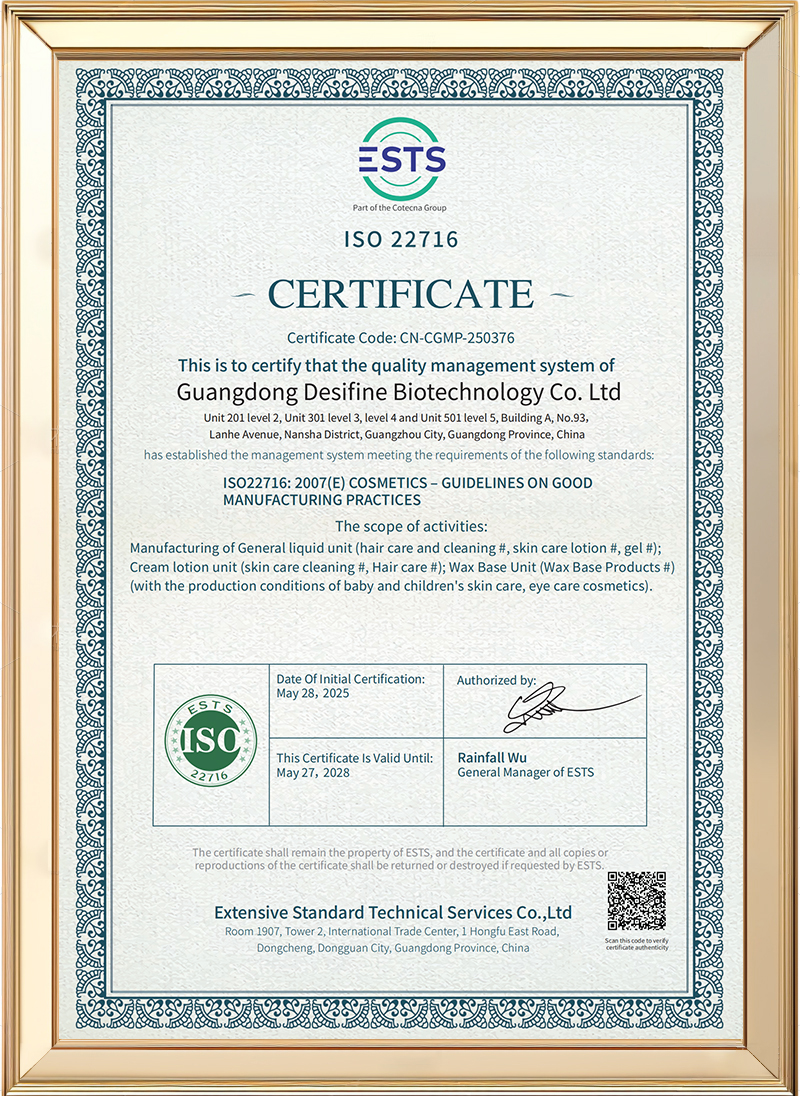
ISO 22716:2007 Cosmetics GMP — Certificate No. CN-CGMP-250376, Sinoanalysis Testing Group, valid to 28 May 2028.
ISO 22716:2007 is the version of cosmetics GMP that international buyers ask for by name. DESIFINE’s certificate No. CN-CGMP-250376 was issued on 28 May 2025 by Sinoanalysis Testing Group and is valid to 28 May 2028, with scope covering skincare, face mask, body care and hair care across Global, USA, EU, Southeast Asia and the Middle East markets.
The difference for a buyer is portability, not prestige. A GMPC certificate demonstrates compliance with a cosmetics GMP framework. An ISO 22716 certificate demonstrates compliance with a named international standard that a brand’s own regulatory reviewer can place directly into a supplier qualification file or a Product Information File without having to argue about equivalence.
FDA Registration — the US facility record
DESIFINE’s FDA Registration No. GTHIVE312-25090 was issued on 8 July 2025 by the U.S. Food and Drug Administration and is valid to 7 July 2028. The registered scope covers cosmetics, skincare, hair care and body care, with the standard listed as FDA 21 CFR Part 700-740 (Cosmetics) / FDA Facility Registration, for the USA and North America market.
For a US launch of a private label scalp hair growth serum, this is the document that shows the manufacturing establishment is registered and operating within the US cosmetics framework. It is not a product approval. Labelling, claim substantiation and market-specific requirements remain with the brand, and the manufacturer’s contribution takes the form of supporting documents rather than a transferable certificate.
Pharmaceutical-grade standard — the discipline behind a leave-on serum
The Desifine OEM/ODM Hair Care Series specification lists three certification points together: GMPC, ISO 22716 and a pharmaceutical-grade manufacturing standard. The third is the point buyers question most, because it is not a dated certificate but a description of the production discipline applied to the line.
For a leave-on scalp product, that distinction carries weight. A hair growth serum stays on the scalp rather than being rinsed away, so the controls governing raw materials, in-process handling and batch consistency matter more than they do for a rinse-off shampoo. In DESIFINE’s Hair Care production, that discipline is supported by an in-house QC laboratory, raw material inspection, semi-finished product testing, a 100% finished-product quality check, third-party testing available through SGS or Intertek, and batch tracking that links a finished unit back to its production batch. The manufacturing base behind it includes a 15,000 m² facility and a 2018 investment of 50 million RMB in production and testing equipment sourced from France, Germany and Switzerland.
Reading the Documents Side by Side
| Document | Issued / applied by | What it covers | Market relevance | Reference | Validity |
|---|---|---|---|---|---|
| GMPC | Sinoanalysis Testing Group | Good Manufacturing Practice for Cosmetics at site level; scope includes hair care | Global, USA, EU, Southeast Asia, Middle East | CN-GMPC-250377 | 28 May 2025 – 27 May 2028 |
| ISO 22716:2007 Cosmetics GMP | Sinoanalysis Testing Group | Compliance with the named international cosmetics GMP standard; scope includes hair care | Global, USA, EU, Southeast Asia, Middle East | CN-CGMP-250376 | 28 May 2025 – 28 May 2028 |
| FDA Registration | U.S. Food and Drug Administration | Facility registration under FDA 21 CFR Part 700-740 (Cosmetics); scope includes hair care | USA / North America | GTHIVE312-25090 | 8 July 2025 – 7 July 2028 |
| Pharmaceutical-grade standard | Production standard applied by Guangdong Desifine Biotechnology Co., Ltd. | Manufacturing discipline applied to the Hair Care series alongside GMPC and ISO 22716 | Applied across export markets | Listed in the Desifine OEM/ODM Hair Care Series specification | Ongoing — not a dated certificate |
How to use the table: match the document to the question being asked. Facility confidence points to GMPC and ISO 22716. US market entry points to the FDA registration. Product-level safety and claims point to the brand’s own Product Information File and safety assessment, supported by the manufacturer’s stability documentation, safety data sheet and batch records. In the EU, Regulation (EC) No 1223/2009 requires the PIF and CPSR regardless of which supplier certificates exist.
The 8-Free Clean Formula and Regional Claim Expectations
The 8-Free Clean Formula used across DESIFINE’s Hair Care series excludes preservatives, fragrance, mineral oil, silicone, traditional emulsifiers, amines and dyes, and is cruelty-free. For a private label organic hair growth serum or a private label plant based hair growth serum, this is the formulation baseline on which clean-beauty positioning is built.
What the formula does not do is write the claim for the brand. Two rules apply in every market: the claim must be accurate for the actual formula, and the supporting documentation must exist. That is where the 8-Free list earns its value — each exclusion is a formulation decision that has to be verifiable in the ingredient declaration and traceable in the batch record, not a line added to a label after production.
Buyer briefs arriving with clean-positioning requests — a private label scalp hair growth serum, a private label women hair growth serum, a private label men hair growth serum or a private label anti hair loss serum — are handled as formulation briefs covering formula, fragrance, color, concentration and function. Requests for a private label alcohol free hair growth serum, a private label extra strength hair growth serum, a private label hair thickening serum or a private label leave-in hair growth serum follow the same route: the ingredient declaration is confirmed at sample stage, and the marketing claim is written from the finished declaration rather than the other way round.
The material library available for these briefs includes natural plant extracts, active peptides, keratin, argan oil, coconut oil, tea tree oil, biotin, caffeine, panthenol, silk protein and amino acids — the ingredients that most clean-positioning and scalp-care briefs in this category are built on.
From Compliance Review to Production Release: Seven Steps
Compliance is not a stage that happens after sourcing; it runs alongside it. The sequence below reflects how a private label hair growth serum project moves from document review to batch release.
- Review the certificate set. Confirm certificate numbers, issuing bodies, scope and validity dates for GMPC (CN-GMPC-250377), ISO 22716 (CN-CGMP-250376) and FDA Registration (GTHIVE312-25090), and check that hair care is inside the stated scope.
- Align the formula and claim brief. Define the target buyer, the positioning and the exclusions required. DESIFINE’s customization scope covers formula, fragrance, color, concentration, packaging, bottle shape, label, logo and private brand name.
- Request samples. Sampling runs 7–10 days, which is the window in which formula and claim questions should be closed — not after production has started.
- Evaluate the sample with its documentation. Stability testing reports, safety data sheets (SDS), product claim support and formula adjustment are part of the after-sales package that accompanies a sample.
- Confirm the sample before mass production. Acceptance criteria for the range include sample confirmation before mass production, pre-shipment inspection, a third-party testing report from SGS or Intertek, and a batch quality certificate.
- Produce. Production runs 30–45 days at a MOQ of 3,000 units per SKU, against a monthly capacity of 500,000 units per month.
- Release and reorder. Batch tracking, batch quality certificates and reorder flexibility keep the second order out of the compliance review cycle.
Two Compliance Paths in Practice
Case 1 — Hair care line for the sensitive-skin market across four countries
A private label beauty brand developed a custom hair care product line for the sensitive skin market across the United States, Canada, the United Kingdom and Italy. The project produced 200,000 pieces and has run as a four-year ongoing partnership. The services that carried it were custom formula for sensitive skin, flexible small batch production, full regulatory compliance support, packaging optimization advice and on-time delivery. The same client’s EU SPF product line was kept compliant with regulations.
Read this as a compliance workflow rather than a volume story. The sensitive-skin brief required formula customization first, and the compliance support was what allowed one supplier to serve four markets with different registration expectations without restarting the qualification process in each one.
Case 2 — Fragrance-free body care line in the United States
A US body care brand launched a fragrance-free body lotion line under a ‘Pure’ clean formula positioning, producing 5 million pieces over three years. The program used the 8-Free clean formula, pharmaceutical-grade quality, batch traceability and reorder flexibility, and resulted in consistent repeat orders with reliable delivery.
The transferable point for serum buyers is that the documentation set — a defined clean formula plus batch traceability — is what makes repeat ordering predictable instead of a fresh negotiation each cycle.
Timelines and Commercial Terms Often Mistaken for Compliance Delays
| Item | Standard | Buyer note |
|---|---|---|
| Sample lead time | 7–10 days | Formula and claim questions are resolved here |
| Production lead time | 30–45 days | Starts after sample confirmation |
| MOQ | 3,000 units per SKU | Applies to the Hair Care series |
| Monthly capacity | 500,000 units per month | Supports repeat and multi-SKU programs |
| Payment terms | 30% deposit, 70% balance before shipment | T/T and L/C at sight accepted |
| Delivery terms | FOB Guangzhou / CIF / DDP | Confirmed per order |
| Acceptance criteria | Pre-shipment inspection, sample confirmation before mass production, third-party testing report (SGS / Intertek), batch quality certificate | These are the documents released with the order |
| Export markets | USA, Europe, Southeast Asia, Middle East, Australia | Local registration rules are confirmed per destination |
Where the confusion usually starts: the 30–45 day production window is often read as evidence of a compliance hold-up. It is the standard production window listed for the series and it begins after sample confirmation. Buyers who run compliance review in parallel with the 7–10 day sampling stage do not lose time. Buyers who begin compliance review after production starts usually do.
FAQ: Private Label Hair Growth Serum Certifications and Standards
What does GMPC certification actually cover for a private label hair growth serum manufacturer?
GMPC certifies the manufacturing site, not an individual product. DESIFINE’s GMPC certificate No. CN-GMPC-250377 was issued on 28 May 2025 by Sinoanalysis Testing Group and is valid to 27 May 2028, with scope covering skincare, face mask, body care and hair care, and market coverage across Global, USA, EU, Southeast Asia and the Middle East. It supports confidence in premises, process control and quality management. It does not replace product-specific safety assessment, and it does not transfer any claim to the brand.
Is ISO 22716 the same as GMPC, and does either replace FDA registration?
No on both counts. ISO 22716:2007 is a named international cosmetics GMP standard; DESIFINE holds certificate No. CN-CGMP-250376, issued 28 May 2025 by Sinoanalysis Testing Group and valid to 28 May 2028, covering skincare, face mask, body care and hair care. GMPC is a separate cosmetics GMP certificate, No. CN-GMPC-250377, valid to 27 May 2028. FDA Registration is a different instrument again: No. GTHIVE312-25090, issued by the U.S. Food and Drug Administration on 8 July 2025 and valid to 7 July 2028, covering cosmetics, skincare, hair care and body care under FDA 21 CFR Part 700-740 (Cosmetics) / FDA Facility Registration. For a US launch, the registration addresses the facility. For the EU, Regulation (EC) No 1223/2009 requires a Product Information File and a safety assessment, and those sit with the brand.
Why does a pharmaceutical-grade manufacturing standard matter for a leave-on scalp serum?
Because the product stays on the skin. A hair growth serum is a leave-on scalp format, so raw material control, in-process handling and batch consistency carry more weight than they would for a rinse-off shampoo. The Desifine OEM/ODM Hair Care Series specification lists GMPC, ISO 22716 and a pharmaceutical-grade standard together, and the production environment behind it includes an in-house QC laboratory, raw material inspection, semi-finished product testing, a 100% finished-product quality check, third-party testing available through SGS or Intertek, and batch tracking for traceability.
How does the 8-Free Clean Formula support clean-beauty and regional claim expectations?
The 8-Free Clean Formula excludes preservatives, fragrance, mineral oil, silicone, traditional emulsifiers, amines and dyes, and is cruelty-free. It gives a brand a concrete formulation baseline for clean positioning — including organic, plant-based and scalp-focused briefs — because every exclusion can be verified in the ingredient declaration and traced in the batch record. It does not create the claim by itself: the finished declaration must match the claim, and the brand’s own market documentation, such as the Product Information File and safety assessment required in the EU, still applies. Customization covers formula, fragrance, color, concentration, packaging, bottle shape, label, logo and private brand name, so the exclusion list is confirmed at sample stage.
Why do samples take 7–10 days while production takes 30–45 days — and is that a compliance delay?
No. Both figures are standard for the range: sampling runs 7–10 days, and production runs 30–45 days after sample confirmation, at a MOQ of 3,000 units per SKU. The production window covers manufacturing, filling and pre-shipment steps including pre-shipment inspection and the batch quality certificate; it is not a waiting period for certification. The practical planning rule is to complete formula and documentation review during the sampling window and confirm the sample before mass production begins. To start that process, request a private label hair growth serum sample or a quotation from DESIFINE at info@desifine.com, or download the company brochure for the full specification set.
What to Do Before You Sign
Three checks separate a smooth launch from a stalled one.
- Match each document to the question it answers. GMPC and ISO 22716 for facility confidence, FDA registration for US market entry, the brand’s own PIF and safety assessment for product-level safety and claims.
- Confirm the formula exclusions at sample stage so the ingredient declaration and the marketing claim are written from the same source.
- Run compliance review in parallel with the 7–10 day sampling window, not after the 30–45 day production window opens.

Guangdong Desifine Biotechnology Co., Ltd. has manufactured OEM/ODM cosmetics from Nansha, Guangzhou since 2000, operating a 15,000 m² facility with 20+ R&D engineers and export business accounting for 60% of total sales across the USA and Europe. The company holds GMPC, US FDA Registration and EU ISO 22716 certification, and was awarded the title of National High-tech Enterprise. The Hair Care series covers shampoo, conditioner, hair mask, hair oil, hair serum, hair wax, hair gel and hair spray, with customization across formula, fragrance, color, concentration, packaging, bottle shape, label, logo and private brand name.
Next step: request a sample or a quotation for your private label hair growth serum program, or download the DESIFINE brochure — Desifine company & product brochure (PDF). Contact: Vicky, info@desifine.com, Tel / WhatsApp +86 13016010480, or visit desifine.com.
Have Questions or Need More Details?
Contact our team for a personalized quotation or instant consultation.
Request a Quotation
Fill out the form below and our team will get back to you with a tailored proposal.
WhatsApp Direct Chat
Prefer to chat in real-time? Message us on WhatsApp for instant assistance & quick answers.
- Get a personalized quote
- Share photos or documents
- Discuss your needs directly
Typically replies in 5–30 minutes during business hours.