
Technical Guide to 8-Free Clean Formulas in Private Label Skincare

An 8-Free clean formula in private label skincare is a controlled formulation specification in which eight named ingredient classes are excluded from the formula, and the exclusion is written into the specification, verified on the batch record, and supported by stability and microbiological evidence produced under certified GMP conditions. The technical difficulty is rarely the list itself. It is proving that the eight items on the brand page, the eight items in the signed specification, and the eight items reflected in the batch record are identical, and that removing them did not weaken stability or consumer safety.
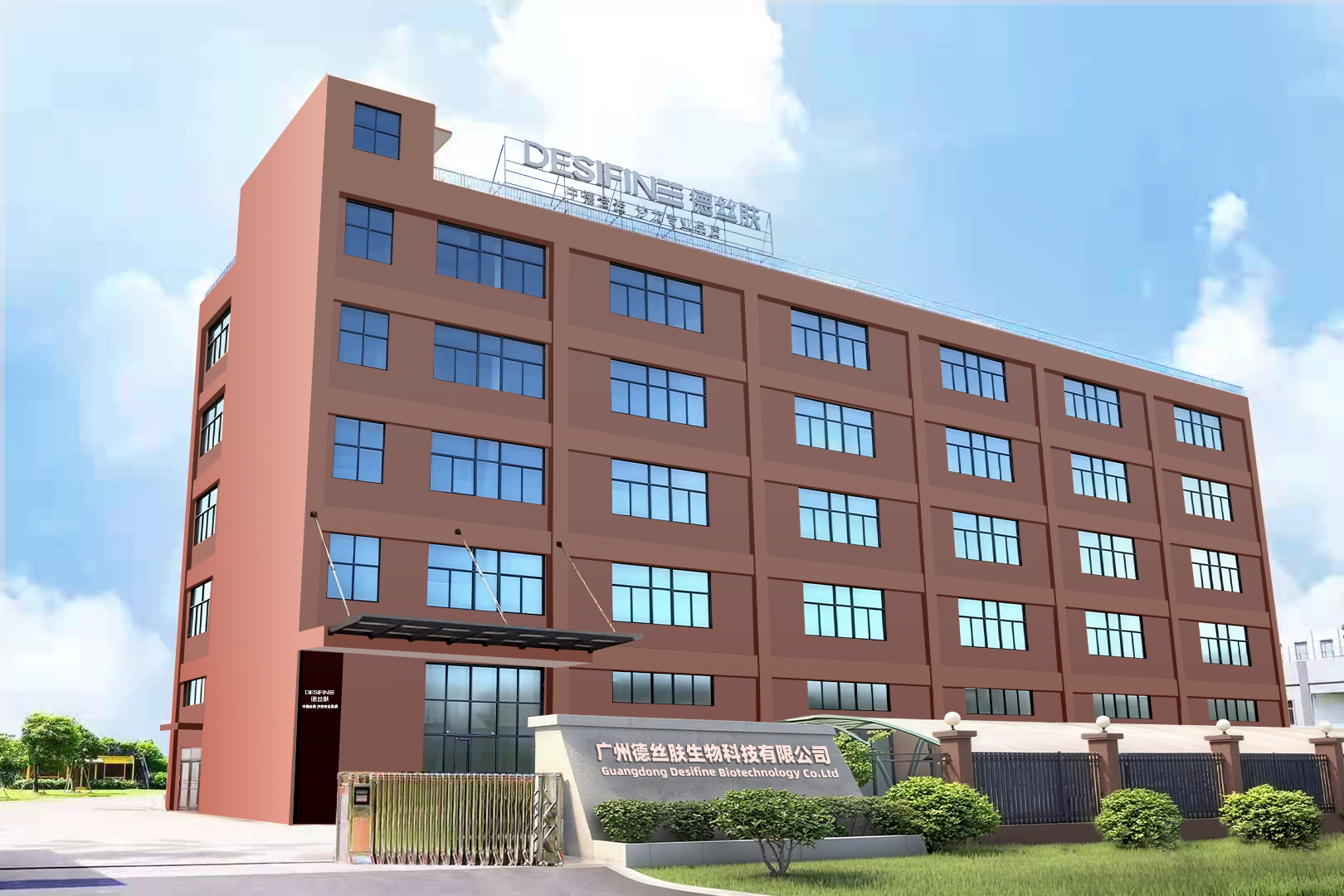
This guide treats 8-Free as an engineering and procurement object rather than a claim. It sets out the parameters to define for each excluded class, the certification boundaries a buyer should test, and a vetting sequence that applies equally to hair care, body care and face care programs. The reference manufacturer used throughout is Guangdong Desifine Biotechnology Co., Ltd. (brand name DESIFINE), a cosmetics OEM/ODM manufacturer founded in 2000 in the Nansha Economic and Technological Development Zone, Guangzhou, China. The company produces skincare, face masks, body care, hair care, anti-aging and lip care products, and states dual GMPC and ISO 22716 certification together with adherence to an 8-Free clean formula standard. One boundary applies to everything below: the exact eight exclusions must be read from the signed formula specification, not from marketing copy, because suppliers assemble the eight positions differently.
Problem Definition: Why 8-Free Is a Verification Problem, Not a Marketing Claim
Free-from has no single legal definition that spans markets. Neither Regulation (EC) No 1223/2009 in the EU nor the MoCRA framework in the United States recognises 8-Free as a regulatory category. Both regulate the finished product, its safety, its labelling and the facility that manufactured it. That leaves the number eight as a commercial specification, useful only when it is written down and version-controlled.
Three failure modes account for most 8-Free disputes in private label programs:
- List drift. SKU A excludes eight classes, SKU B excludes seven plus one different class, and both ship under the same claim. This happens when the exclusion list lives in a brand deck rather than in a versioned specification.
- Undisclosed substitution. A class is removed and replaced by a chemically different system that carries its own restriction or allergen profile. The claim stays true while formulation risk increases.
- Unvalidated stability. Removing a preservative, an oxidation-stable emollient or a fragrance changes microbiological and oxidative behaviour, and the change surfaces in market months later instead of in the lab.
DESIFINE's own risk documentation names the same pressure points at manufacturing level: raw material supply fluctuation, formula stability during shipping, and compliance differences across markets. The stated control methods are multiple raw material suppliers, stability testing before shipment, pre-shipment inspection and a batch traceability system. That list is a useful buyer checklist because it describes where an 8-Free program actually breaks.
Industry Background: The Regulatory Floor Beneath a Clean-Formula Claim
The United States: registration, listing and reporting
The Modernization of Cosmetics Regulation Act of 2022 (MoCRA) is described by FDA as the most significant expansion of FDA authority over cosmetics since the FD&C Act was passed in 1938. For an 8-Free private label skincare program sold in the US, four obligations sit underneath the claim. Facilities that manufacture or process cosmetics must register with FDA and renew registration every two years. Each marketed product must be listed with its ingredients and updated annually. A responsible person must report serious adverse events to FDA within 15 business days, accompanied by a copy of the relevant product label. And safety substantiation must exist for the product. None of these obligations is satisfied by an ingredient exclusion.
The European Union: framework, GMP standard and notification
Regulation (EC) No 1223/2009 is identified by the European Commission as the main regulatory framework for finished cosmetic products placed on the EU market. The harmonised GMP standard identified by the Commission is EN ISO 22716:2007, Cosmetics - Good Manufacturing Practices. Products are notified through the Cosmetic Products Notification Portal, and the Commission states that one CPNP notification removes the need for any further national-level notification within the EU. For a buyer sourcing private label skincare for France or Italy, the same EU framework applies, while a responsible person and a product information file still have to be in place before notification.
Why an exclusion list can never override a restriction list
Sunscreen is the clearest test case. In Europe, sunscreen products are regulated as cosmetic products under Regulation (EC) No 1223/2009, and UV filters carry their own restrictions. Under Regulation (EU) No 2022/2195, the UV filter Homosalate was restricted as of 1 January 2025 to face products, with non-compliant products to be withdrawn by 1 July 2025. A formula marketed as free-from is still bound by that restriction. The lesson generalises: the 8-Free list is a brand-level specification layered on top of the regulatory floor, never a replacement for it.
Category scale and trade framing
The US private label cosmetics market was valued at USD 11.41 billion in 2025 and is projected at USD 12.02 billion in 2026, reaching USD 18.13 billion by 2034. The global organic shampoo market is projected to reach USD 3.14 billion in 2026. These figures describe the scale of the categories in which clean-formula programs compete. They do not demonstrate demand for any specific eight-item exclusion list and should not be presented as proof of one. For import scoping, HS 3304 covers skin-care preparations including sunscreen preparations, and HS 3305 covers hair preparations. Both are useful for classifying shipments and neither substantiates a claim.
Detailed Solution: Five Parameters to Define for Each Excluded Class
A defensible 8-Free standard is built class by class, and every class needs the same five parameters. If a supplier cannot answer all five for a given class, that class is not under control, it is only advertised.
- Definition and scope. Which functional class is excluded, and does the rule extend to salts, derivatives and precursor-releasing compounds? A preservative-free statement without a derivative rule is not testable.
- Functional role. What the excluded material actually did in the formula: preservation, odour masking, emolliency, film formation, foaming, viscosity, colour, chelation or solubilisation.
- Replacement system. What now performs that function, at what level, sourced from which raw material suppliers, and whether the replacement carries its own restriction or allergen profile.
- Evidence. Stability data, microbiological challenge results, packaging compatibility, sensory panels and shipping-condition testing for that specific formula version.
- Documentation. Specification version, batch-record field, certificate of analysis fields, claim wording approved per market, and change-notification terms.
Applied across the classes that private label buyers most often place inside an eight-item specification, the technical consequences look like this:
| Exclusion class | What it did in the formula | What changes technically | Evidence to request |
|---|---|---|---|
| Preservatives | Controlled microbial growth in the water phase | Microbiological control shifts to plant hygiene, raw material bioburden, packaging and pH or water-activity design; challenge testing becomes the critical proof | Challenge test report, preservative-free manufacturing controls, per-batch micro specifications |
| Fragrance | Odour masking plus brand signature | Raw material odour becomes visible to the consumer; odour acceptance criteria and pack barrier requirements tighten; allergen exposure profile changes | Sensory and odour panel results, raw material odour specifications, stability in the final pack |
| Mineral oil | Low-cost occlusive emollient with high oxidation stability | Emollient load shifts to vegetable oils and esters with different oxidation profiles; rancidity, colour drift and viscosity change must be managed | Accelerated and real-time stability, peroxide value monitoring, antioxidant strategy |
| Silicone | Sensory modification, film formation, combing performance | Rub-out, after-feel and film uniformity change; emulsifier and rheology systems need rebuilding | Sensory panel data, film performance testing where relevant, pack compatibility |
| Sulfate surfactants | Foaming, cleansing and viscosity building in shampoo | Foam volume, foam texture and viscosity response change; milder systems usually require secondary thickeners and a different salt response | Foam and viscosity data, mildness testing, elevated-temperature stability |
| Dyes | Visual identity and batch-to-batch colour consistency | Colour drift over shelf life becomes visible; appearance must be managed through packaging or accepted as natural variation | Colour stability data across shelf life, light-barrier pack specification |
| Drying alcohols | Quick-dry feel and secondary preservation | Dry-down time, texture and microbial load change; fragrance solubilisation may need a new route | Micro challenge results, sensory data, pack component compatibility |
| Chelating agents | Water hardness control and preservative potentiation | Preservative efficacy and colour stability can shift with water quality; process water specification becomes a control point | Water system validation, efficacy data, stability across water hardness ranges |
The eight positions above are shown as the classes most frequently assembled into an 8-Free specification in the private label market. Because suppliers define the eight differently, the binding list for any program is the one written into the signed specification. This table is a reading framework, not a statement of any specific supplier's list.
What an 8-Free choice means for stability
Stability is where clean-formula programs are won or lost. Removing a preservative system does not remove the need for microbiological control, it relocates that control to the manufacturing environment, the water system, the packaging and the challenge-test protocol. Removing an oxidation-stable emollient such as mineral oil shifts the oxidation burden onto oils that react faster with oxygen and light. Removing fragrance removes an odour mask that was previously hiding raw material variability. In each case the formula becomes more dependent on process discipline than on the ingredient that was removed.
This is why the stability programme, not the exclusion list, deserves the most attention during supplier vetting. A supplier running multi-round destructive testing, stability testing before shipment, pre-shipment inspection and batch traceability is demonstrating the operational capability an 8-Free formula requires. A supplier offering the claim without those controls is offering a document, not a product.
Step-by-Step Breakdown: A Seven-Step Vetting Sequence
- Write the exclusion list into the RFQ. Replace the phrase 8-Free with eight named classes and a derivative rule. Ask every candidate to confirm or decline each class in writing.
- Request the formula dossier and the replacement rationale. You need the formula version identifier, the function each excluded class performed, and the system that replaced it, including the raw material supplier for each replacement.
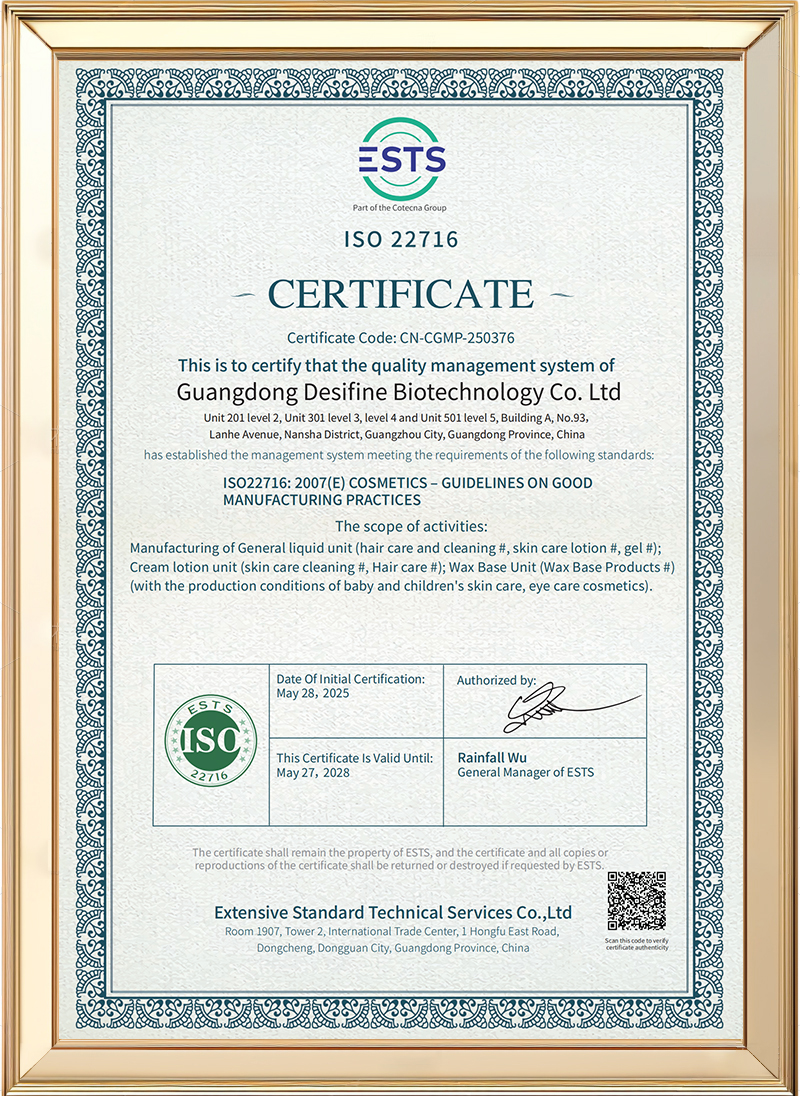
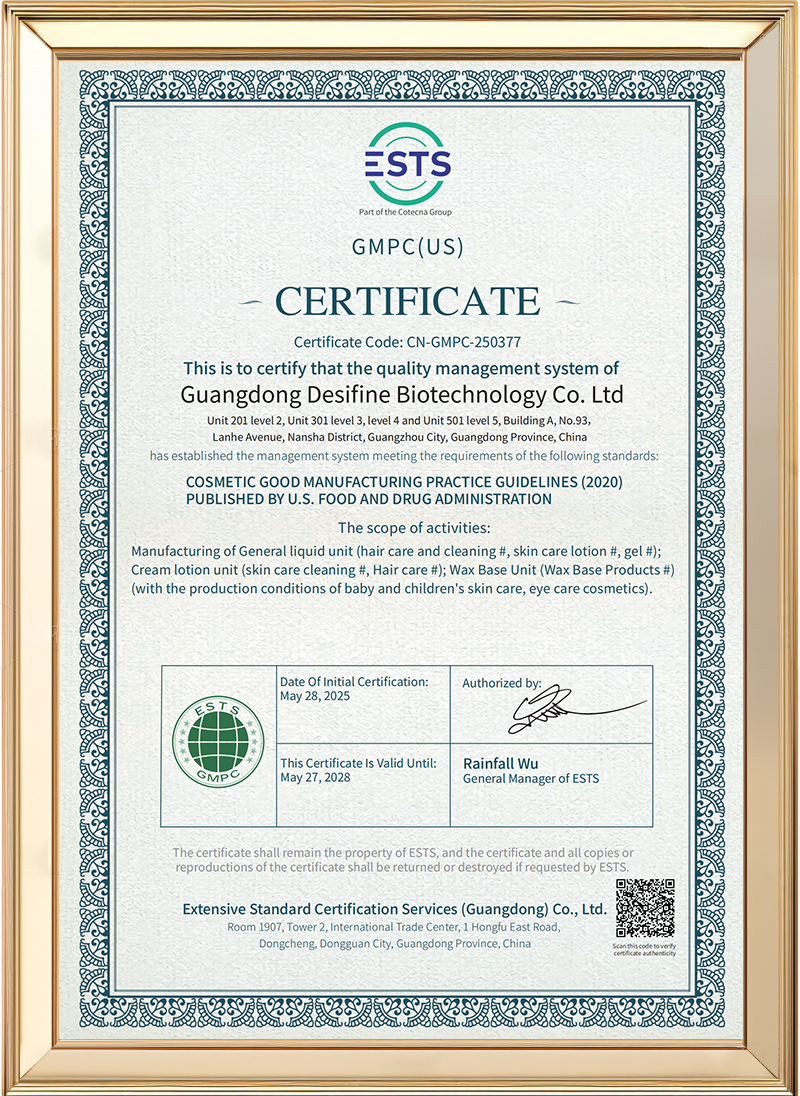
- Verify certification scope and certificate numbers. DESIFINE holds dual GMPC and ISO 22716 certification, with GMPC certificate CN-GMPC-250377 and ISO 22716 certificate CN-CGMP-250376, alongside US FDA registration. Check that the certificate scope covers the product category you are buying and the site that will actually manufacture. A certificate covering a different site or a different category does not transfer.
- Review the stability and compatibility evidence. Multi-round destructive testing, stability testing before shipment, pre-shipment inspection and batch traceability are the four controls that convert a claim into a reproducible product.
- Test the sample against the written list. Evaluate odour, texture, foam, rub-out, colour and pack compatibility. These sensory outcomes are the visible consequences of the exclusions and the place where undisclosed substitution usually appears.
- Map market documentation. For the EU: responsible person, product information file and CPNP notification. For the US: facility registration with two-year renewal, product listing with annual updates, and an adverse-event process able to report a serious event to FDA within 15 business days with the label copy attached.
- Lock control into the quality agreement. Specification version control, change notification before any substitution, qualified second sources for each excluded class and its replacement, batch traceability identifiers, and an approval workflow for claim wording in each market.
Use Cases: Applying the Framework to Hair Care, Body Care and Face Care
Hair care: private label shampoo suppliers and organic positioning
In shampoo, the exclusion decisions with the largest technical consequences are sulfate surfactants and silicone. Foam volume, foam texture, viscosity response and wet-comb performance are all functions of the systems being removed, so the validation question is not whether a shampoo is sulfate-free but whether the replacement system delivers acceptable foam and viscosity across the shelf life and in the chosen pack format. Buyers sourcing private label organic shampoo should note a separate boundary: an 8-Free standard does not itself establish organic certification, and organic positioning requires its own documented chain of evidence.
Body care: emollient substitution and longer in-use windows
Body care formulas typically carry high emollient loads, so mineral oil and silicone exclusions change oxidation and sensory behaviour more than in a light lotion. Larger pack formats and longer in-use periods also extend microbiological exposure, which raises the value of challenge testing and pack compatibility work. The practical vetting question is whether the stability data covers the actual pack rather than a laboratory jar.
Face care: anti-aging actives and restricted ingredients
Face care concentrates risk. Anti-aging private label skincare programs combine multiple actives with a preservation strategy, and every exclusion changes the compatibility map. Where a sunscreen is placed on the EU market, the formula must satisfy both the brand's exclusion list and the UV filter restrictions, including the Homosalate restriction under Regulation (EU) No 2022/2195, which means the exclusion list and the restriction list must be reviewed together rather than sequentially. Where a claim moves a product toward a different regulatory category, such as a hair growth serum claim, claim substantiation is a separate question from the 8-Free standard and has to be resolved on its own evidence.
Sourcing markets: USA, China, Canada, France and Italy
For private label skincare USA programs, the MoCRA obligations described above form the documentation backbone. For private label skincare China manufacturing, the practical checks are certificate scope and export experience: DESIFINE reports a 60% export ratio with the USA and Europe as main markets, from a 15,000 m² facility with 82 employees and an annual output of 5,000,000 units. For France and Italy the EU framework and the CPNP route apply. Canada was outside the regulatory scope of the framework set used in this analysis, so Canadian requirements should be confirmed separately with the responsible person before a claim is finalised.
Comparison Tables for Supplier Vetting
Table 1 - What each document proves, and what it does not
| Document | What it confirms | What it does not confirm |
|---|---|---|
| GMPC Certificate CN-GMPC-250377 | Cosmetic GMP conformity of the certified site within the certificate's stated scope | That a specific SKU's formula excludes the eight named classes |
| ISO 22716 Certificate CN-CGMP-250376 | Conformity with cosmetics GMP as represented by EN ISO 22716:2007, the standard listed by the European Commission as harmonised | Ingredient exclusions, claim wording, or market-specific notification |
| US FDA registration | Facility registration under the MoCRA framework, renewed every two years | Product listing, safety substantiation, or formula composition |
| Product listing (US) | Ingredient information for a marketed product, updated annually | That excluded classes were verified analytically |
| Batch record, CoA, stability report | The composition and test results of the batch actually produced | That the claim complies in every destination market |
Table 2 - Category application of the same 8-Free standard
| Category | Highest-pressure exclusions | Validation focus |
|---|---|---|
| Hair care (shampoo) | Sulfate surfactants, silicone | Foam, viscosity, wet comb, elevated-temperature stability |
| Body care | Mineral oil, silicone, fragrance | Oxidation, colour drift, challenge testing in the actual pack |
| Face care / anti-aging | Preservatives, fragrance, dyes | Active compatibility, challenge testing, sensory, pack compatibility |
| Sunscreen (EU market) | Fragrance, silicone, dyes | UV filter restriction compliance alongside the exclusion list, film performance, stability |
The supplier's own comparison documentation frames dual GMPC and ISO 22716 certification, a pharmaceutical-grade manufacturing standard, a large formula library and the 8-Free clean formula standard as its stated differentiators against other private label cosmetic and skincare OEM/ODM manufacturers. Read those as claims to be verified against certificates, dossiers and batch records rather than as conclusions.
FAQ
Does an 8-Free clean formula satisfy US or EU compliance on its own?
No. An 8-Free formula is a formulation specification, while market compliance is a separate framework. In the EU, finished cosmetic products are placed under Regulation (EC) No 1223/2009, GMP guidance is represented by EN ISO 22716:2007, and products are notified through the Cosmetic Products Notification Portal, where one CPNP notification removes the need for further national-level notification within the EU. In the US, the MoCRA framework requires facility registration renewed every two years, product listing that includes ingredients and is updated annually, and reporting of serious adverse events to FDA within 15 business days with a copy of the product label. An exclusion list cannot override these obligations, and it cannot override ingredient restrictions either, as the EU restriction on Homosalate under Regulation (EU) No 2022/2195 illustrates.
Can one 8-Free standard be applied across hair care, body care and face care?
The standard can be written once, but its technical consequences differ by category and each category needs its own validation file. Removing sulfate surfactants changes foaming and viscosity in shampoo. Removing mineral oil or silicone changes emolliency and sensory behaviour in body care and face care. Removing fragrance changes odour control everywhere. A manufacturer whose product scope covers skincare, face masks, body care, hair care, anti-aging and lip care can hold a single exclusion policy, but buyers should request category-specific dossiers: the exclusion list, the replacement system, stability results, and the batch-record field that proves the exclusion at production. DESIFINE's documentation cites 10,000+ formula reserves and an R&D team of 20+ engineers; those are capacity and development indicators, not proof for a specific SKU.
Does an 8-Free formula change the budget of a private label program?
Verified public data does not establish comparable private label quotations, so a defensible budget cannot be built from published prices. Cost is driven by the formulation itself, including the replacement systems and their raw material cost, then by packaging, order quantity per SKU, the testing scope the buyer requires, and delivery terms. The practical approach is a structured RFQ that applies the same eight exclusions to every quoted SKU, states the testing scope explicitly, and separates formulation development from production. That allows quotes from China, the USA or Europe to be compared on identical scope rather than on headline unit price.
How should a buyer validate an 8-Free sample before mass production?
Validate the sample against the written exclusion list, not against the claim. Request the formula version the sample was produced from, the batch record, and the test reports. Compare the sample's sensory profile with expectations for odour, texture, foam, rub-out and colour, because those are the visible consequences of removing fragrance, silicone, sulfate or dye. Then confirm that stability has been addressed for shipping conditions, that multi-round destructive testing has been performed on that formula, and that pre-shipment inspection and batch traceability are written into the agreement. Requesting the sample through the supplier's technical contact rather than a sales channel keeps the specification version traceable.
What determines lead time for an 8-Free private label program?
Lead time is set by validation rather than by production speed alone. Two forces dominate: how much formulation work the exclusions require, and how long stability and compatibility testing takes for the replacement system. A large ready-formula library shortens the development stage because the base formula does not have to be built from zero, while raw material supply fluctuation is the second variable and is controlled by qualifying multiple raw material suppliers for each excluded class and its replacement. DESIFINE's stated position is a 15,000 m² facility, 5,000,000 units annual output and a 60% export ratio with the USA and Europe as main markets; capacity figures indicate scale, while the binding lead-time question is always the testing protocol you agree to. To convert this evaluation into a dated plan, request a sample and a quotation with a testing schedule at info@desifine.com.
Conclusion
An 8-Free clean formula is only as strong as its documentation. The exclusion list must be defined class by class, with a derivative rule, a named replacement system, stability and microbiological evidence, and a batch-record field that proves the exclusion at production. Certification then has to be read correctly: GMPC certificate CN-GMPC-250377 and ISO 22716 certificate CN-CGMP-250376 confirm site-level GMP conformity within their stated scope, and US FDA registration confirms facility registration under the MoCRA framework, but neither confirms that a given SKU's formula excludes the eight named classes.
The decision rule for buyers is simple. Judge a supplier on the four controls that convert a claim into a reproducible product: multi-round destructive testing, stability testing before shipment, pre-shipment inspection and batch traceability. Then judge the program on the frameworks that outrank the claim: Regulation (EC) No 1223/2009 and EN ISO 22716:2007 with CPNP notification for the EU, and MoCRA registration, listing and adverse-event reporting for the US. Applied that way, an 8-Free standard becomes a procurement asset rather than a marketing phrase.
Next Step: Sample, Quote and Technical Documentation
DESIFINE (Guangdong Desifine Biotechnology Co., Ltd.) supports private label skincare, face mask, body care, hair care, anti-aging and lip care programs from its 15,000 m² facility in Nansha, Guangzhou, with dual GMPC and ISO 22716 certification and an 8-Free clean formula standard.
Request a sample, a quotation with a testing schedule, or the technical brochure: Download the DESIFINE brochure (PDF)
Contact: Vicky | Email: info@desifine.com | Tel: +86 13016010480 | WhatsApp: +86 13016010480 | Website: desifine.com
Address: No. 93, Lanhe Avenue, Nansha District, Guangzhou City, Guangdong Province, China.
Have Questions or Need More Details?
Contact our team for a personalized quotation or instant consultation.
Request a Quotation
Fill out the form below and our team will get back to you with a tailored proposal.
WhatsApp Direct Chat
Prefer to chat in real-time? Message us on WhatsApp for instant assistance & quick answers.
- Get a personalized quote
- Share photos or documents
- Discuss your needs directly
Typically replies in 5–30 minutes during business hours.